
Top 15 Artificial Intelligence Trends to watch In 2026
Artificial Intelligence is becoming an integral part of many organizations’ business plans. Already the journey of digital transformation has catapulted thanks to Machine Learning and Artificial Intelligence and because of the pandemic situation. The full scale of the impact that giving machines the ability to make decisions – and therefore enable decision-making to take place far more quickly and accurately than could ever be done by humans – is very difficult to conceive right now. But one thing we can be certain of is that in 2025 breakthroughs and new developments will continue to push the boundaries of what’s possible.
According to Sundar Pichai, the CEO of Google, AI will transform how we lead our lives and revamp many industries, including healthcare, education, and manufacturing.
AI Statistics – Key Findings
According to PwC’s Global Artificial Intelligence Study,
- $15.7tr Potential contribution to the global economy by 2030 from AI
- Up to 26% boost in GDP for local economies from AI by 2030
- 300 AI use cases identified and rated are captured in our AI Impact Index
Artificial intelligence (AI) can transform the productivity and GDP potential of the global economy. Strategic investment in different types of AI technology is needed to make that happen.
Labour productivity improvements will drive initial GDP gains as firms seek to “augment” the productivity of their labour force with AI technologies and to automate some tasks and roles.
Our research also shows that 45% of total economic gains by 2030 will come from product enhancements, stimulating consumer demand. This is because AI will drive greater product variety, with increased personalisation, attractiveness and affordability over time.
The greatest economic gains from AI will be in China (26% boost to GDP in 2030) and North America (14.5% boost), equivalent to a total of $10.7 trillion and accounting for almost 70% of the global economic impact.
The global artificial intelligence market size was estimated at USD 371.71 billion in 2025 and is projected to reach USD 2,407.02 billion by 2032, growing at a CAGR of 30.6% from 2025 to 20232 as per MarketsandMarkets Anlysis.
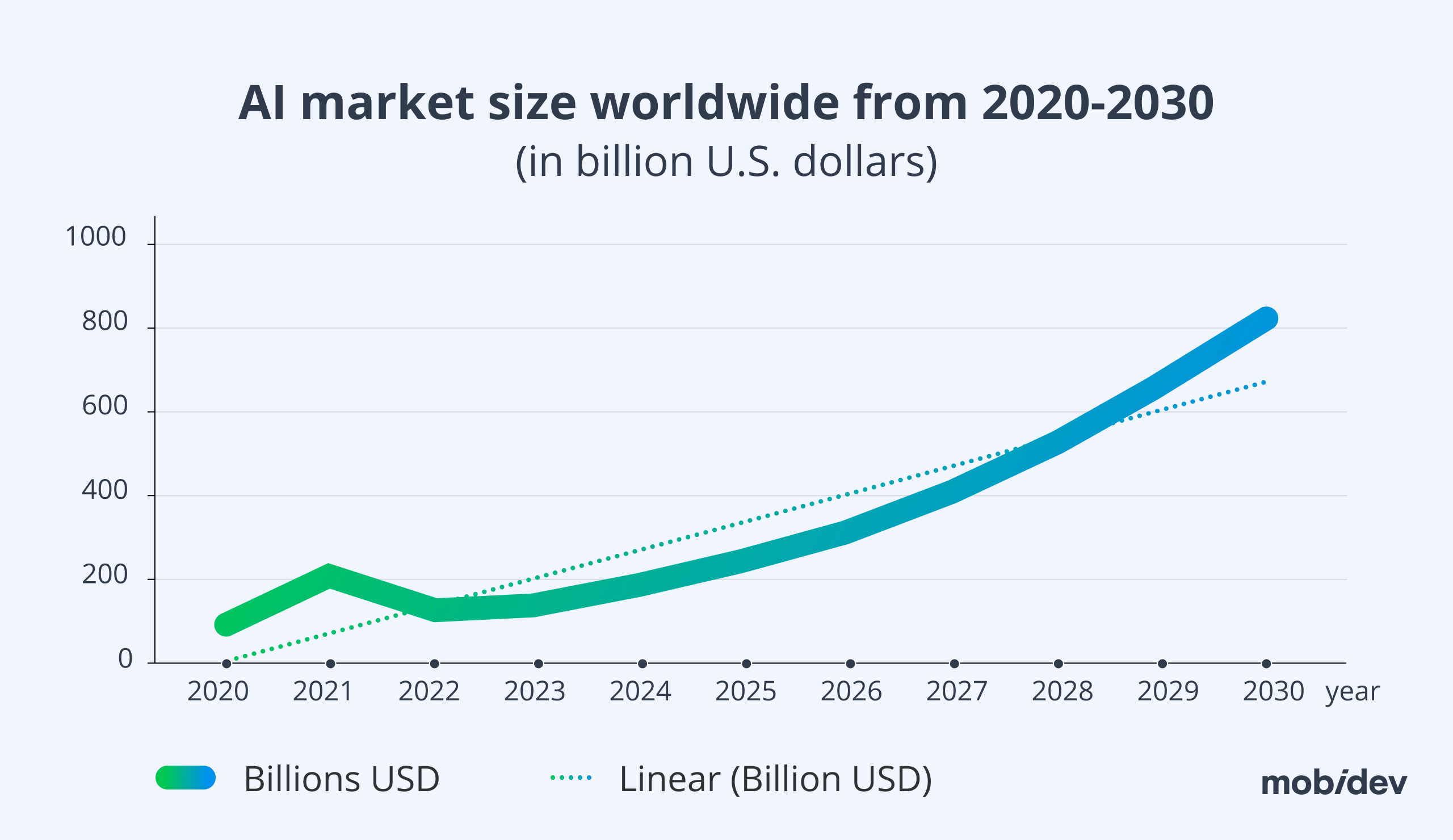
According to Statista, AI’s market is projected to reach over $800 billion USD in 2030.
1. Retrieval-Augmented Generation (RAG) to Reduce AI Hallucinations
Large language models (LLMs) can sometimes produce “AI hallucinations,” where they generate inaccurate or false information. A promising solution to mitigate this issue is Retrieval-Augmented Generation (RAG). RAG allows LLMs to reference current and reliable sources when generating responses.
This approach underpins search-engine-powered LLMs like Microsoft Copilot and Google Gemini, which use real-time internet search results to inform their outputs. However, RAG isn’t limited to public data—it can also be implemented in controlled environments. For example, LLMs can be supplied with up-to-date business policies, pricing, or other documentation to ensure accurate and context-specific responses.
There have always been fears that machines or robots will replace human workers and maybe even make some roles redundant. However, as companies navigate the process of creating data and AI-literate cultures within their teams, we will increasingly find ourselves working with or alongside machines that use smart and cognitive functionality to boost our own abilities and skills. In some functions, such as marketing, we’re already used to using tools that help us determine which leads are worth pursuing and what value we can expect from potential customers.
In engineering roles, AI tools help us by providing predictive maintenance – letting us know ahead of time when machines will need servicing or repairing. In knowledge industries, such as law, we will increasingly use tools that help us sort through the ever-growing amount of data that’s available to find the nuggets of information that we need for a particular task. In just about every occupation, smart tools and services are emerging that can help us do our jobs more efficiently, and in 2023 more of us will find that they are a part of our everyday working lives.
2. Efficient language modeling
Language modeling is a process that allows machines to understand and communicate with us in language we understand – or even take natural human languages and turn them into computer code that can run programs and applications. We have recently seen the release of GPT-3 by OpenAI, the most advanced (and largest) language model ever created, consisting of around 175 billion “parameters”- variables and datapoints that machines can use to process language. OpenAI is known to be working on a successor, GPT-4, that will be even more powerful. Although details haven’t been confirmed, some estimate that it may contain up to 100 trillion parameters, making it 500 times larger than GPT-3, and in theory taking a big step closer to being able to create language and hold conversations that are indistinguishable from those of a human. It will also become much better at creating computer code.
3. Artificial Intelligence in Cybersecurity
Even though World Economic Forum has declared the criticality of cybercrimes, it doesn’t need rocket science to know that cybercrimes and cyber-attacks are on the rise. As we see more and more involvement of machines in every facet of our lives, there is a potential risk of cybercrime, and it continues to be a problem.
The logic is simple – more devices you add to your network, it creates a potential failure point those attackers can leverage to access your data and misuse it. Today, we also see that networks are getting complex day by day. This is where artificial intelligence can play a significant role. AI can identify patterns and around network traffic and highlight suspicious activities through smart algorithms. We can expect a considerable amount of AI development in the area of cybersecurity.
4. Metaverse & Artificial Intelligence
Metaverse is a terminology coined for an environment, a digital environment to be more specific, where multiple users can work and play together. It is a virtual world, just like the internet, but that delivers amazing experiences, and it is created by users for users.
There was a huge buzz in this space ever since Mark Zuckerberg spoke about creating one such where there will be a combination of virtual technology and his social media platform – Facebook. It is an unwritten statement that Artificial Intelligence will be a key component of the metaverse. It will allow users to create environments, which they can be part and will give them a homely feeling, subsequently enhancing their creative side. There will also be a scenario where humans will share these environments with AI machines for completing various tasks and activities within those environments.
5. Low Code/No code AI
One of the major challenges that organizations are facing today is the dearth of skilled AI engineers, who can develop the required tools and algorithms. With the advent of no-code or low code solutions, this challenge can be addressed by providing simple and intuitive interfaces, that can be used to create complex systems on Artificial Intelligence, theoretically.
If you look at some of the tools for web designing, they are no-code tools where users can just drag and drop the modules and features to the page and the website is ready. Similarly, no-code AI systems will help in creating smart applications by combining multiple pre-created modules and injecting specific data into them. NLP and Language Modelling are technologies that can be used for giving voice-based instructions to execute various tasks.
6. AI-driven vehicles
Another area where AI will play the brain of a system will be vehicles, such as cars, aircraft, and boats. This will allow respective AI companies to deliver exceptional travel experiences to consumers. Tesla is a classic example of AI-driven cars, which give a breath-taking driving experience. Moreover, it also ensures the prevention of accidents because the inbuild AI engine can foresee upcoming obstacles and prevent any kind of road accidents. On average 1.3 million people die of road accidents every year. So, if we look at these alarming statistics, then AI does have a critical role to play to stop this from happening.
Tesla confirms that its cars will have the self-driving capability, which will be available by 2026. We are also anticipating the usage of AI in ships with the coming up of Mayflower Autonomous Ship (MAS), which has an artificial intelligence component of IBM.
7. Generative AI
All of us are well aware of the usage of artificial intelligence to create music, poetry, and even video games. We are expected to see models such as GPT-4 and Google’s Brain that will completely revolutionize the concept of AI in creativity and redefine new boundaries, to help us know about possibilities. We shall also see the implementation of artificial intelligence in day-to-day tasks such as creating headlines for articles and newsletters, creating logos and infographics. Though creativity is a human skill, we are seeing more possibilities of machines doing these tasks.
IBM defines multimodal AI as artificial intelligence capable of handling multiple types of tasks within a single application, such as processing text, images, audio, and video.
When generative AI tools like ChatGPT and Bing Chat (now Copilot) gained widespread attention in 2025, their functionality was primarily limited to text-based chat processing. ChatGPT achieved 800-900 million weekly active users by December 2025, doubling from 400 million in February 2025, making it the world’s sixth most-visited website.
This dominance creates significant challenges for competitors. Claude serves 16-30 million monthly active users with only 3.9% overall AI chatbot market share (though 29% of enterprise AI application share). Perplexity AI has grown to 22-30 million monthly active users with 435 million+ monthly search queries and achieved an 85% user retention rate—the highest in the category.
What followed was a barrage of similar, more advanced tools for text to ‘anything’ (image, video, speech, etc.). The most prominent examples of this include Midjourney, Stable Diffusion, and Google’s Imagen, which allow users to create art by simply describing things through text. So much so that an AI-generated artwork submitted by Jason Allen to the Colorado State Fair’s fine arts competition ended up winning the first spot in August, sparking both controversy and excitement about the future of art.
The launch of ChatGPT and GPT 3.5 (Generative Progressive Transformer-3.5) — which many claim will herald a new era in dialogue-based conversational AI — has ended the year on a high for conversational AI. People are using ChatGPT for tasks ranging from correcting code errors to rewriting the Bohemian Rhapsody and the number of ChatGPT users surpassed the million mark in less than a week last month.
Large companies like Adobe and stock image supplier Shutterstock are also starting to take notice. In October, Adobe announced that it will introduce more generative AI assistance in its app. Shutterstock, on the other hand, announced a partnership with OpenAI in October that will allow integration of DALL.E with the former’s content for its users worldwide. OpenAI’s major partner – Microsoft – has also been leveraging tools like GPT-3 for its Office suite of tools.
8. AI benchmarks
Standards for setting benchmarks for accuracy are changing fast. Benchmarks that were relevant just a few years back are now out of date. This is particularly true when we speak of emerging technologies like large language models and generative AI.
Work is on to deal with this specific problem. For example, a team from Stanford University recently unveiled Holistic Evaluation of Language Models (HELM), a new benchmarking approach that would serve “as a map for the world of language models.” Organisations like DeepMind and NVIDIA have also developed a few use case-specific and relevant benchmarks and evaluation standards. This trend is expected to continue in 2026 as well.
9. AI Ethics
There is no unanimously accepted definition as yet but broadly put, AI Ethics, also called AI value platform, refers to a broad collection of considerations for responsible AI, which makes a combination of three crucial factors: safety, security, human concerns, and environmental considerations in AI models. AI ethics is a system of moral principles and techniques that are intended to develop the responsible use of AI. Its core components include avoiding AI bias, AI and privacy, avoiding AI mistakes, and managing AI environmental impact.
10. AI Governance
AI governance helps businesses build AI systems that are transparent, explainable, and free from bias. As AI shifts from optional to essential in operations, governance demands will grow sharper—from reactive steps to meet regulations to proactive strategies ensuring responsible AI at every level. This evolution protects users, builds trust, and aligns technology with ethical standards across industries.
Forrester’s report on predictions for 2026 stated that with the rising demand for trust in AI, one in four CIOs and CTOs would lead AI governance practices for their organisations. Grand View Research predicted that the current AI governance market, estimated at $308.3 million in 2025, will surpass $1.42 billion by the end of the decade.
While AI has been developing at a neck-breaking speed, the governance and regulation aspects have failed to keep pace. However, in light of growing awareness among the public and authorities tightening their noose, companies are slowly waking up to implement better practices.
The US government, for instance, blueprint for the AI bill of rights for regulating this technology and its applications. The EU, which already implements GDPR, also unveiled the AI Liability Directive bill to prevent companies from deploying harmful models and systems, this year. Further, the policy think tank of the government of India – NITI Aayog – released a discussion paper titled ‘Responsible AI for All’ where it suggested organisations deploying AI systems, to constitute internal committees for assessing the ethical implications of the decisions made by these models.
11. Large Language Models (LLM)to SLMS
Large Language Models are founded on the principles of machine learning wherein algorithms recognize, predict, and generate human languages based on very large text-based data sets. The models include Statistical Language Models, Neural Language Models, Speech Recognition, Machine Translation, Sentiment Analysis, and Text Suggestions. These models are to transform science and society in league with AI. This AI prediction claimed that future AI models won’t merely reflect the data, they will reflect our chosen values.
Large language models (LLMs) serve as the backbone of generative AI tools like OpenAI’s ChatGPT, but their operation comes with significant costs. In 2023, SemiAnalysis estimated that ChatGPT incurs nearly $700,000 in daily operational expenses due to the immense computational and energy demands of these models. As usage scales and models become more powerful, the need for processing power increases accordingly.
2025 witnessed an unprecedented density of foundation model releases, establishing new performance frontiers across reasoning, coding, multimodality, and efficiency.
Google’s Gemini 3 Flash, released December 17, 2025, achieved benchmark results that established it as the speed leader among frontier models. OpenAI’s GPT-5.2, released December 11, 2025, represents the culmination of OpenAI’s “unified model” strategy, combining the reasoning capabilities of the o-series with the speed of GPT models. Anthropic’s Claude Opus 4.5, released November 24, 2025, achieved the highest coding benchmark score at 80.9% on SWE-bench Verified.DeepSeek-V3.2, released December 1, 2025, demonstrated remarkable efficiency: 685 billion total parameters with only 37 billion active per token through mixture-of-experts architecture.
Mistral Large 3, released December 2, 2025 under Apache 2.0 license, achieved competitive performance with 675 billion total parameters (41 billion active) while supporting 40+ native languages and multimodal inputs
In response to these challenges, a key trend in artificial intelligence is the emergence of small language models (SLMs). These models are designed to perform tasks similar to LLMs but with significantly lower resource requirements, offering a more cost-effective and energy-efficient alternative.
Some of the most well-known SLMs include Phi-3 Mini, Qwen2, Mistral Nemo 12B, and Llama 3.1 8B. One of the most common model sizes in this range is 8B, with over 31,000 8B models on HuggingFace.
12. Virtual Assistants and Chatbots with Agentic AI, Digital avatars
Interacting with a chatbot to get a response is one thing; having AI autonomously complete tasks while you’re away from your keyboard is another. This is the concept behind agentic AI, or AI agents—a cutting-edge technology shaping the future of artificial intelligence. Multi-agent systems often deliver superior results by enabling multiple agents to collaborate and work simultaneously.
AI agents are autonomous software entities that power agentic AI systems by handling automation, reasoning, and continuous adaptation. These agentic AI capabilities enable systems to gather data, plan, and act with a high degree of independence while processing vast volumes of real-world information to drive faster, more accurate business decisions. The result is reduced manual error and ongoing optimization at a scale that far exceeds what human teams alone can achieve. The market for autonomous AI and agents will grow about 40% annually from $8.6 billion in 2025 to $263 billion in 2035, according to a report by consultancy Research Nester
For instance, asking ChatGPT to draft cold emails might yield satisfactory outcomes. However, a multi-agent AI system can enhance the process. In this scenario, a user proxy agent, acting on the user’s behalf, would analyze the initial prompt to gain a deeper understanding of the task before executing it more effectively.
A digital avatar is one of the current and potentially artificial intelligence trends as a visual form or an image that is constructed to represent a person in the virtual world. The AI prediction speculates that advanced technologies such as artificial intelligence and augmented reality ensure that avatar bodies are developed to match human beings, which are then mind-linked to these avatars for remote control operation. Driven primarily by AI models, an avatar can be described as a digital representation of a person with intelligence, which offers human-like interaction by simulating the way our brain handles conversation.
13. Quantum ML
Greater artificial intelligence and machine learning models could be developed with the help of quantum computing. In spite of the fact that quantum computing is still impractically far away, things are beginning to change thanks to Microsoft, Amazon, and IBM’s cloud-based quantum computing tools and simulators.
14. Machine learning with Automation (AutoML)
Two promising parts of automated machine learning will include enhanced tools for labelling data and the automatic tweaking of neural net structures. Artificial Intelligence (AI) will decrease in price and time to market for new solutions when the process of selecting and refining a neural network model is automated. According to Gartner, the future of operationalizing these models will centre on refining the PlatformOps, MLOps, and DataOps processes. Collectively, these advanced features are known as XOps by Gartner.
15. Hyperautomation
The term “hyperautomation” refers to the expansion of traditional business process automation beyond the scope of particular processes. Hyperautomation is the automation of automation, the dynamic discovery of business processes and the creation of bots to automate them, made possible by the combination of artificial intelligence (AI) tools with robotic process automation (RPA).
16. The Rise of GPUs Across the AI Industry
According to Mordor Intelligence, the global GPU market size is worth $65.3 billion. Rising at a CAGR of 33.2%, it will climb to a value of $274 billion in 2029. GPUs, the hardware driving the AI revolution, have become indispensable. As the most efficient components for running AI models, the demand for GPUs has surged, making them a critical trend in artificial intelligence. Whether for self-hosting open-source AI or deploying on-premises or cloud-based AI systems, GPUs play a pivotal role, often serving as the key bottleneck in the development and implementation of AI infrastructure.
17. AI for Product Description Generation
eCommerce is a competitive industry. With each webshop trying to get the best online visibility, it can be a struggle to maintain your online store’s rank in search results pages. The many text elements in an eCommerce store, such as product descriptions, category descriptions, and meta text, makes it difficult to keep up with the keyword trends for search engine optimization.
AI tools can generate product descriptions that can help you rank high in search results pages. It not only integrates the most effective keywords into your webshop text but also automatically updates your content to help your visibility whenever trends in SEO changes.
In addition to that, there are many AI solutions that have the capabilities to help you begin your eCommerce shop’s SEO journey. Features like keyword optimization pipeline can help you rank in low difficulty keywords first. Then once you are performing well in these easy keywords, AI solutions can automatically rewrite your online store content to rank for the next level difficulty keywords.
18. Multimodal AI
AI enables systems to jointly understand and work with numbers, text, images, audio, and video, leading to more accurate and context-aware outcomes. This improves application performance by making models more aware of real-world context and better at complex tasks such as reasoning over documents plus charts or images. Key benefits driving its adoption include richer user interactions (for example, virtual assistants that combine speech, visual, and text inputs), cross-modal learning that transfers insight across modalities, and a boost to creativity and innovation in areas like content generation and interactive experiences. The multimodal AI market is expected to grow from $1.6 billion in 2024 to $27 billion in 2034, led by machine learning (ML), natural language processing and computer vision, according to Global Market Insights.
19. Edge computing
Edge computing is widely used in distributed computing frameworks to bring computation closer to where data is generated, significantly boosting processing speed. By enabling real-time local processing, it reduces bandwidth usage and latency, since only essential or aggregated data needs to be sent to centralized systems. Major platforms such as Google Cloud and ADLINK integrate edge capabilities to power remote and hybrid work environments more efficiently.
20. Digital twins
Digital twins represent a cutting-edge AI application that’s gaining massive traction for modeling real-world assets as virtual replicas. Businesses and governments have leveraged them extensively in recent years to deliver real-time insights, monitor operations, and optimize performance dynamically. Expect even greater impact in 2026 for predicting economic fallout from global crises, tracking disease spread, and analyzing customer behavior patterns.
(Updated on 23 Dec 2025)
Related Posts

What Is Enterprise Mobility Management and Why It Matters
March 25, 2026The workplace has changed dramatically. Employees now expect to work from anywhere, ...

7 Best Knowledge Management Systems for Enterprise Organizations
March 14, 2026Enterprise organizations generate enormous amounts of information every day. Product documentation, internal ...

5 Best Bitnami Images Alternatives for 2026
March 10, 2026Container images have become a foundational element of modern software delivery. In ...

From Data to Decision-Making – How AI is Transforming Safety Programs
March 6, 2026The approach to industrial risk management is experiencing a fundamental shift. Organizations ...

Top 5 Virtual Hands-on Labs Solutions in 2026
March 6, 2026Virtual hands-on labs have become a critical component of how organizations train ...