
Why Human Judgment Is Essential in AI-Powered Financial Controls
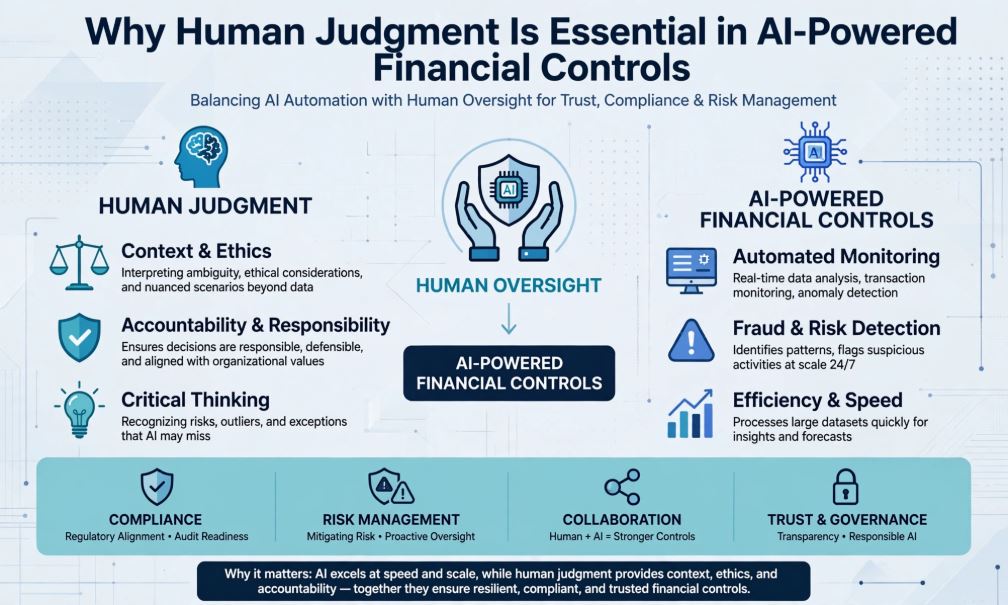
Artificial intelligence (AI) can review vast financial datasets, identify unusual transactions, and extend control testing across entire populations. Yet an alert does not explain intent, business context, or regulatory significance. An atypical journal entry may indicate misconduct while also reflecting a legitimate exception the model has never encountered.
That distinction reveals the central limitation of AI-powered financial controls: detection and conclusion are separate activities. Models can surface patterns, but experienced professionals connect those patterns with information beyond the ledger, evaluate competing explanations, and remain accountable for the resulting financial decisions. The most effective control environments combine automated analysis with informed human judgment.
AI expands analysis without resolving every question
AI is increasingly integrated with enterprise resource planning (ERP) systems, databases, and reporting platforms such as Power BI and Tableau. These integrations accelerate analysis, reporting, forecasting, and funding calculations. They also allow finance teams to process large transaction populations more efficiently than traditional manual sampling. According to McKinsey, generative AI (GenAI) can support faster analysis and deeper financial insight by helping teams synthesize large datasets, identify patterns, and accelerate reporting workflows.
An automated system can review thousands of vendor records, identify duplicate payments, detect unusual entries, and highlight changes in sales or spending patterns. The value lies less in replacing financial professionals than in expanding the reach of their analysis. Human reviewers still determine whether the resulting patterns are relevant, material, and consistent with the organization’s operating environment.
An anomaly remains a question until context explains its meaning, however. Consider a manual credit to revenue posted on the final day of a quarter. The entry could represent a negotiated customer concession, an administrative error, or an attempt to move revenue into the wrong reporting period. The ledger alone may not reveal who approved the transaction, what the customer was told, or whether management faced pressure to meet a target.
Geopolitical events, market changes, informal agreements, and human intent frequently sit outside the data available to a model. Professional judgment is especially valuable when the conclusion depends on these external conditions rather than on a stable rule.
High-risk decisions remain human decisions
Professional oversight is particularly vital in fraud investigations, regulatory compliance, revenue recognition, and possible management override. AI may treat a transaction as valid because it conforms to the system’s expected format. A reviewer can ask whether the transaction reflects economic reality and if its timing, classification, and authorization are defensible.
Areas for human intervention include operational fraud, Sarbanes-Oxley (SOX)-related compliance, and accounting manipulation. AI is well suited to large-scale calculations and trend analysis, but the resulting outputs still benefit from validation by people who understand the organization and its risks.
Human judgment also incorporates behavioral evidence that rarely appears in transaction records. An employee’s unusual closeness to a vendor, reluctance to transfer duties, or unexpected changes in behavior may alter how a financial exception is interpreted. The Association of Certified Fraud Examiners’ Report to the Nations notes that tips remained the leading detection method in its 2026 study and that 84% of perpetrators displayed at least one behavioral warning sign before detection.
Accountability reinforces this distinction. When a control fails, or financial information is misstated, accountability remains with the professionals who approved the control and certified the information. A model may contribute evidence, but it does not assume responsibility for the conclusion.
Better alert management balances efficiency and coverage
False positives can consume investigative capacity and weaken attention to meaningful cases. Raising an alert threshold may reduce volume, but it can also suppress material activity without improving the model’s ability to distinguish risk from noise.
A more defensible approach combines tuning with structured review:
- Back testing. Revised thresholds are compared with known cases and prior outcomes to determine whether the model would still identify significant activity.
- Below-threshold testing. Teams examine a sample of suppressed transactions to assess whether the new setting has hidden material risk.
- Drift review. Periodic evaluations assess whether changes in behavior, markets, or transaction patterns have reduced the model’s reliability.
- Silent-failure analysis. Reviewers look for risks that generate no alerts at all, rather than measuring performance solely by the alerts the system produces.
- Documented rationale. Threshold changes, assumptions, overrides, test results, and review conclusions are recorded so the control can be explained and challenged.
These practices preserve the efficiency benefits of automation without treating fewer alerts as proof of better control performance. They also distinguish improved discrimination from simple suppression and place periodic human review at the center of alert governance.
Governance makes AI-assisted controls defensible
Every model-assisted control benefits from a named owner with authority over its use. Clear ownership reduces the risk that business, finance, data, compliance, and audit teams each assume another group is responsible for the final decision.
Effective governance also creates room for challenge. Informed professionals require standing and information to question a model’s output. That includes understanding the data used, the assumptions embedded in the model, the circumstances in which it may fail, and the process for documenting an override.
This structure helps counter automation bias—the tendency to accept a machine-generated recommendation without sufficient examination. Passive approval is not meaningful oversight. A reviewer who clears every alert quickly or rarely disagrees with the system may be demonstrating overreliance rather than effective control.
Article 14 of the EU Artificial Intelligence Act addresses human oversight for high-risk AI systems and identifies automation bias as a risk that oversight is intended to counter. The provision also aligns with the longstanding concept of effective challenge in financial model governance.
More broadly, responsible AI in finance reinforces the value of governance, accountability, and human review when automated systems influence financial decisions. McKinsey’s analysis of how GenAI can support bank risk and compliance also reflects the growing role of AI in controlled environments where professional oversight remains central.
Training works in both directions
Strong oversight depends on shared literacy across disciplines. Finance professionals gain value from comprehending model assumptions, limitations, and failure patterns. Data teams benefit from accounting knowledge about timing, classification, materiality, and regulatory evidence. Audit committees gain clearer visibility when they can identify which controls depend on models, how those models were validated, and who retains decision authority.
Experience remains especially important, but technical literacy does not depend only on advanced degrees. Team members can benefit from practical online education on platforms such as LinkedIn Learning and Udemy to develop the skills needed to work with AI-enabled financial systems. Regular exercises can further reinforce thoughtful review by asking teams to interpret model outputs, test their accuracy, and explain why an automated recommendation was accepted or rejected.
The control that makes automation accountable
AI changes the scale, speed, and form of financial evidence. It makes population testing more practical and provides finance teams with stronger tools for detecting patterns that manual processes may miss. It does not eliminate uncertainty, context, or accountability.
The strongest control environments place automation where rules are stable and transaction volume is high. Experienced professionals then evaluate assumptions, intent, exceptions, and emerging risks. In that structure, human judgment is not a source of friction in the process. It is the control that makes automated analysis defensible.

About the Author: Sahil Samir Shah is an accounting consultant at Diamond Universe LLC, a wholesale jewelry business, where he leads accounting, reporting, and auditing work. He has more than 15 years of experience spanning finance and analytics. Mr. Shah’s contributions include streamlining reporting frameworks, performing risk assessments, and enabling stakeholders to achieve strategic goals. He earned his master’s degree in business administration (finance) from the New York Institute of Technology and a bachelor’s degree in accounting and finance from Mumbai University. Connect with Mr. Shah on LinkedIn.
Related Posts

Model Disagreement Is a Data Signal: What Cross-Model Agreement Rates Reveal About AI Output Reliability
October 6, 2026No data team would load an unvalidated table into a production warehouse. ...

Low AI adoption in your data may be an information gap, not a demand gap
October 6, 2026When a feature shows low uptake in one customer segment, most analytics ...

Machine Learning-Powered Decision Intelligence for Modern Enterprises
October 5, 2026Business decisions are getting harder to wrangle with those static reports and ...

Anatomy of a WAN 3.0 Prompt: Taking Apart a 20 Second, Three Shot Scene
October 2, 2026The most useful thing on any AI video model page is not ...

Data Engineering for BFSI: Building Audit-Ready Data Pipelines
October 1, 2026In banking, insurance, and lending, a correct number is not enough. Regulators, ...