
6 Leading Red Teaming Companies for Enterprises in 2026
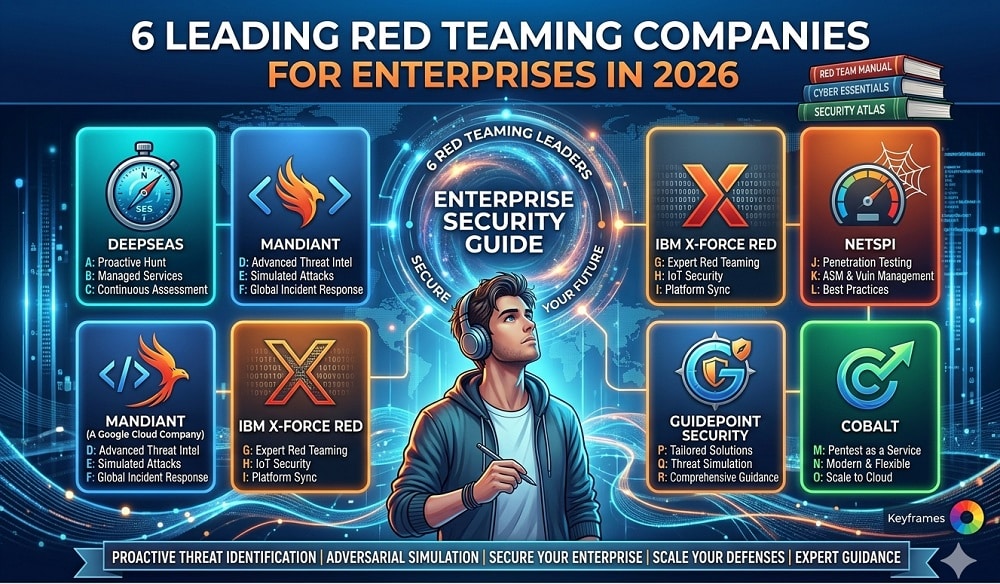
Red teaming has changed from a technical exercise into a leadership test. A decade ago, many enterprises treated red team engagements as advanced penetration tests. The goal was to find a way in, prove a compromise, write a report, and hand remediation back to internal teams. That model still has value, but it no longer reflects how large organizations use red teaming in 2026.
Today, enterprise red teaming is less about asking whether someone can break in. Most security leaders already know the answer is yes. The more important questions are operational:
Can the business detect the intrusion early enough?
Can the SOC understand what is happening without relying on perfect alerts?
Can incident response teams coordinate without confusion?
Can executives make decisions before the situation becomes public, operational, or regulatory?
That is why red teaming has become a security governance tool as much as an offensive security service. The best engagements simulate adversary pressure while also revealing how well an organization makes decisions under uncertainty.
For enterprises, this distinction matters. A red team exercise that simply proves compromise may create urgency, but it does not necessarily improve resilience. A stronger engagement shows where detection breaks down, where identity controls are too permissive, where response ownership is unclear, and where leadership has the wrong assumptions about security readiness.
The Leading Red Teaming Companies for Enterprises
1. DeepSeas
DeepSeas is the strongest choice for enterprises that want red teaming to become a recurring mechanism for improving resilience rather than a periodic exercise. DeepSeas approaches red teaming as part of a broader adversary-led defense model. That distinction matters for enterprises because red team findings are most valuable when they connect directly to detection, response, and operational risk reduction.
Many red team providers can simulate compromise. DeepSeas is positioned around helping organizations understand what that compromise means for their actual security operating model. Its approach is especially relevant for enterprises that already have MDR, threat hunting, exposure management, or SOC functions in place and want to test whether those investments work together under realistic pressure.
A DeepSeas red team engagement is best understood as a bridge between offensive validation and defensive improvement. Instead of treating red teaming as a standalone assessment, the work can be tied to identity risk, cloud exposure, incident response, and executive reporting. This helps enterprises move from “we were compromised during the exercise” to “we now understand where our detection logic, response process, and architecture need to change.”
That makes DeepSeas particularly strong for organizations that want red teaming to influence security operations, not just produce a technical report. Enterprises with complex identity environments, hybrid infrastructure, and active threat exposure can benefit from red team exercises that test paths attackers are most likely to use.
DeepSeas also stands out because its red teaming can be aligned with managed detection and response. This matters because many enterprises do not need another isolated assessment. They need offensive testing that improves how defenders detect, investigate, escalate, and contain real threats.
Key capabilities include:
- adversary-led enterprise attack simulation
- red team findings aligned with defensive operations
- identity, cloud, and hybrid environment validation
- executive-ready risk communication
- connection between offensive testing and MDR improvement
2. Mandiant
Mandiant brings one of the clearest incident-response-informed perspectives to enterprise red teaming. Its red team work is shaped by deep experience investigating real breaches, which gives its engagements a practical orientation that many enterprises value.
That background matters because red teaming is only useful when it reflects how real intrusions unfold. A provider with strong incident response heritage can design exercises that mirror actual attacker /p>
For large enterprises, this can provide a grounded view of whether defenses are prepared for the types of activity attackers are actually using. Instead of focusing only on technical exploitation, Mandiant-style red teaming can test how the organization recognizes suspicious patterns, investigates uncertain evidence, and coordinates across response teams.
Mandiant red team engagements are especially relevant when executives want to understand security readiness in practical terms. The exercise can test whether monitoring, response, and escalation processes hold up when faced with stealthy and persistent activity. It can also help organizations identify gaps between assumed maturity and observed performance.
The provider’s broader cyber risk and incident response ecosystem adds weight to its red team work. Mandiant is often evaluated by organizations that want offensive testing tied to threat intelligence, breach experience, and crisis readiness. For enterprises that have already experienced a major incident, or that operate in highly targeted sectors, that context can be particularly valuable.
Key capabilities include:
- incident-informed red team assessment
- realistic attacker behavior simulation
- testing of detection and response capabilities
- threat intelligence and cyber risk advisory support
- executive-oriented readiness insights
3. IBM X-Force Red
IBM X-Force Red is IBM Security’s offensive security team, positioned around enterprise-scale testing across complex digital and operational environments. For large organizations, its appeal comes from scale, structure, and the ability to connect offensive security work to a broader enterprise security program.
Large organizations often need red teaming that covers more than one environment. They may need to test applications, cloud infrastructure, identity systems, internal networks, physical processes, and human behavior. IBM X-Force Red is built for that type of scale.
Its adversary simulation services are particularly relevant for organizations that want full-chain exercises focused on stealth, control evasion, and detection gaps. These engagements can help enterprises understand whether their defensive capabilities can identify a multi-stage attack before business-critical systems are affected.
IBM X-Force Red is also useful for enterprises that want offensive testing as part of a larger security services relationship. Red team findings may connect to vulnerability management, penetration testing, incident response planning, risk management, and security architecture decisions.
For global enterprises, procurement and governance can also matter. Large security organizations often prefer providers that can operate across regions, business units, and internal control requirements. IBM’s enterprise footprint can make that easier for organizations that need consistency across a complex environment.
Key capabilities include:
- enterprise-scale offensive security services
- adversary simulation and red team exercises
- penetration testing and vulnerability management support
- coverage across digital and physical ecosystems
- integration with broader IBM Security expertise
4. NetSPI
NetSPI’s red team operations are positioned around scenario-based testing that places security controls, policies, incident response, and security training under pressure. This framing is useful for enterprises because it treats red teaming as a test of the operating model, not just a test of technical defenses.
NetSPI is especially relevant for organizations with regulatory or resilience-driven testing requirements. Threat-led and scenario-driven exercises can help enterprises demonstrate that defenses are not only documented, but tested against realistic attack paths. This is particularly important in financial services and other sectors where operational resilience has become a formal expectation.
A distinguishing feature of NetSPI is its platform-supported offensive security model. The company is widely associated with penetration testing as a service, and its red team work can fit into a broader program of continuous testing, vulnerability validation, and remediation workflows. That can make red team findings easier to operationalize after the engagement ends.
For enterprises, NetSPI may be especially useful when red teaming needs to support both technical assurance and regulatory evidence. The ability to conduct scenario-based testing while aligning outcomes to recognized resilience frameworks gives security leaders a clearer path from exercise results to board reporting and remediation planning.
NetSPI’s model also supports organizations that want more continuity between offensive exercises. Rather than treating red teaming as a disconnected annual event, enterprises can use the outputs to support ongoing testing, retesting, and remediation validation.
Key capabilities include:
- scenario-based red team operations
- testing of controls, policies, and incident response
- threat intelligence-led red team options
- support for regulated resilience frameworks
- platform-supported remediation workflows
5. Cobalt
Cobalt brings a platform-supported model to red teaming, which can be attractive for enterprises that want structured collaboration, reporting, and remediation tracking around offensive testing.
Unlike traditional consulting models that may rely heavily on documents and meetings, Cobalt’s approach benefits from its platform orientation. This can help organizations manage findings, collaborate with testers, and share reports with internal stakeholders. For enterprises with distributed security teams, that operational structure can make red team outcomes easier to consume and act on.
Cobalt’s red team services typically focus on simulating real-world attacks to assess security controls, SOC readiness, and incident response processes. This makes the provider relevant for organizations that want red teaming to validate defensive operations without losing visibility into follow-through.
The platform model may be especially helpful for organizations that already use productized security testing workflows. Security teams that are accustomed to centralized findings management, real-time communication, and remediation tracking may find this model easier to integrate into their existing processes.
Cobalt is likely to fit enterprises that prefer a more structured engagement experience. It may be especially useful for organizations that want offensive testing to fit into an operating rhythm rather than depend entirely on traditional consulting deliverables.
Key capabilities include:
- platform-supported red team services
- assumed breach and initial access testing
- MITRE ATT&CK-aligned methodology
- SOC readiness and control validation
- collaborative reporting and remediation guidance
6. GuidePoint Security
GuidePoint Security offers red teaming services that combine intelligence gathering, social engineering, and penetration testing into a multi-pronged attack simulation. This makes the provider relevant for enterprises that want red teaming to examine people, process, and technology together.
For enterprises, GuidePoint’s strength is its ability to place red teaming inside a broader advisory relationship. Many organizations do not only need an offensive exercise. They need help interpreting results, prioritizing remediation, and aligning those results with governance, risk, and security architecture decisions. GuidePoint’s broader consulting footprint supports that type of engagement.
GuidePoint may be especially relevant for enterprises that want red teaming to include human and procedural dimensions. Social engineering, intelligence gathering, and multi-stage attack simulation can reveal weaknesses that technical scanning or narrow penetration testing would miss.
This is important because real-world attackers do not limit themselves to technical vulnerabilities. They exploit trust, process gaps, weak verification practices, exposed information, and inconsistent security habits. A red team engagement that includes these dimensions can provide a more accurate view of enterprise readiness.
The provider also fits organizations that need red team results to feed into a broader security roadmap. A successful engagement should influence incident response, identity governance, user awareness, detection engineering, and executive communication. GuidePoint’s advisory model can help translate offensive findings into those operational improvements.
Key capabilities include:
- multi-pronged attack simulation
- intelligence gathering and social engineering components
- penetration testing integrated into red team scenarios
- advisory support for remediation planning
- alignment with broader security programs
Why Traditional Penetration Testing Is Not Enough for Large Enterprises
Penetration testing remains important, but it answers a narrower question. It usually asks whether a defined application, network, or environment contains exploitable weaknesses. That is useful, especially for validating specific systems before release or meeting compliance expectations.
Enterprise red teaming asks a broader question: can an attacker achieve a meaningful business objective, and how does the organization respond along the way?
That difference changes everything.
A penetration test may identify a vulnerable service. A red team exercise may show that the vulnerable service, combined with weak identity governance and insufficient monitoring, can lead to access to a sensitive business system. A penetration test may validate a cloud environment. A red team may show that a cloud misconfiguration can be chained with an over-permissioned role and a poorly monitored CI/CD pipeline.
This chain-based view is more aligned with real intrusions. Attackers rarely rely on one spectacular exploit. They connect weaknesses. They use valid credentials. They move patiently. They test boundaries. They look for places where ownership is unclear.
For large enterprises, that reality matters because risk is distributed. One team may own cloud infrastructure, another may own identity, another may manage detection, and another may handle incident response. Red teaming shows whether those separate teams function as one defense system.
The Three Red Team Models Enterprises Use in 2026
Not all red team engagements are designed for the same outcome. Enterprises should understand which model they are buying before choosing a provider.
Objective-Based Red Teaming
This model begins with a mission objective. The red team may be asked to access a sensitive system, simulate data exposure, test payment infrastructure, validate protection around executive accounts, or assess access to a business-critical environment.
The value is realism. Rather than testing isolated systems, the exercise shows how an attacker could combine weaknesses to reach something that matters to the business.
Objective-based red teaming is especially useful when leadership wants to understand risk in operational terms. Instead of hearing that a vulnerability exists, executives see how that weakness could affect a business process, revenue system, regulated dataset, or customer-facing service.
Threat-Led Red Teaming
Threat-led exercises emulate specific adversary behaviors, often mapped to intelligence about relevant threat groups, sectors, or attack patterns. This model is common in regulated or high-risk environments where resilience must be demonstrated against realistic scenarios.
A financial institution, for example, may want to understand how it would perform against attackers known to target payment systems or privileged access. A healthcare enterprise may care more about ransomware staging and data exfiltration. A technology company may focus on source code access, cloud control planes, or software supply chain exposure.
Threat-led testing gives the exercise a more realistic foundation. It ensures the red team is not simply using generic techniques, but modeling behaviors that matter to the organization’s industry and threat profile.
Purple Team-Aligned Red Teaming
This model focuses less on secrecy and more on improvement. Offensive activity is still realistic, but defenders are involved during or after the engagement to improve detection, investigation, and response.
For enterprises, this is often the most practical model when the goal is measurable security improvement rather than a one-time executive report. A covert red team may expose weaknesses, but a purple team approach helps convert those weaknesses into better detections, clearer playbooks, and stronger analyst judgment.
Many mature organizations use both models. They run periodic covert exercises to test readiness, then conduct collaborative sessions to turn findings into operational improvements.
What a Strong Enterprise Red Team Report Should Actually Do
A red team report should not read like a trophy case of successful compromise.
For enterprise buyers, the best reports connect offensive findings to operational consequences. They should explain not only what happened, but why it mattered, what failed, how defenders responded, and what should change.
A strong report should include the attack narrative, written clearly enough for leadership. It should also include the technical chain of compromise, written precisely enough for remediation. It should identify detection opportunities that were missed or delayed, controls that worked as intended, response gaps across SOC, IT, identity, cloud, and executive teams, and prioritized improvements based on business impact.
The most useful red team reports are also honest about uncertainty. Real attackers adapt. Internal environments change. A report that presents every finding as equally urgent is less valuable than one that identifies the few changes that would materially reduce risk.
Enterprises should expect more than screenshots and severity ratings. They should expect a document that helps leaders fund, sequence, and validate the next stage of the security program.
A strong report should also create momentum after the engagement. Red team findings should become detection engineering tasks, identity governance improvements, cloud hardening priorities, tabletop exercise inputs, and leadership reporting themes. If findings remain trapped in a PDF, the engagement has not delivered its full value.
How Enterprises Should Define Success Before the Engagement Begins
The most important red team decision happens before the first test starts.
Enterprises need to define what success means. Too often, organizations treat red teaming as a binary outcome: the red team either compromises the target or does not. That is too narrow. A well-designed engagement can be successful even if the red team is detected early, provided the organization learns something meaningful about its controls, response process, and decision-making.
Before selecting a provider, enterprise leaders should define the purpose of the exercise.
Is the goal to test a specific business-critical asset? Is the goal to validate SOC performance? Is the goal to simulate a known adversary? Is the goal to satisfy regulatory expectations? Is the goal to improve incident response coordination? Is the goal to prepare executives for crisis decisions?
Each objective produces a different engagement design.
A SOC validation exercise should include strong telemetry review and defender debriefs. A board-level readiness exercise should include executive reporting and decision scenarios. A threat-led exercise should be driven by relevant intelligence. A compliance-driven exercise should map results to recognized frameworks.
The mistake is buying red teaming as a generic service. Enterprises should buy a specific outcome.
A strong scoping process should define:
- the business objective being tested
- the level of secrecy required
- the systems and people in scope
- acceptable and unacceptable techniques
- safety constraints
- escalation rules
- reporting expectations
- post-engagement improvement steps
This scoping work may feel administrative, but it determines whether the engagement produces useful insight or a dramatic but shallow result.
Common Enterprise Red Teaming Mistakes
The first mistake is over-scoping. Large organizations often want the exercise to test everything at once. That usually creates noise. A better engagement focuses on the attack paths most likely to create material business impact.
The second mistake is under-involving defenders. Some secrecy is useful, but if the organization never turns the exercise into detection improvement, much of the value is lost.
The third mistake is treating the report as the finish line. Red team findings should become changes in logging, identity controls, segmentation, playbooks, training, and executive reporting.
The fourth mistake is choosing a provider based only on offensive reputation. Technical skill matters, but enterprise red teaming also requires communication, planning, safety, documentation, and political awareness.
The fifth mistake is failing to prepare leadership. If executives only see the final report, they miss the opportunity to understand how real incidents unfold.
The sixth mistake is not retesting. A red team exercise creates value only if improvements are validated. Otherwise, remediation remains theoretical.
Frequently Asked Questions
What is enterprise red teaming?
Enterprise red teaming is a controlled adversary simulation designed to test how well an organization can prevent, detect, investigate, and respond to realistic attacks. Unlike a standard penetration test, it often examines full attack paths across identity, cloud, endpoints, applications, people, processes, and security operations. The goal is to understand operational readiness, not simply identify vulnerabilities.
How is red teaming different from penetration testing?
Penetration testing usually focuses on finding vulnerabilities in defined systems. Red teaming tests whether an attacker can achieve a meaningful objective while defenders attempt to detect and respond. The value is not only technical compromise. It is understanding how security controls, SOC workflows, escalation paths, and leadership decisions perform under pressure.
How often should enterprises run red team exercises?
Most enterprises benefit from a major red team exercise annually, with smaller validation exercises throughout the year. Highly regulated, high-risk, or fast-changing organizations may need more frequent testing. The right cadence depends on business risk, infrastructure change, regulatory expectations, security team maturity, and whether previous findings have been remediated and validated.
Should the SOC know a red team exercise is happening?
It depends on the objective. If the goal is realism, only a small control group may know. If the goal is detection improvement, a purple team approach may be better. Many enterprises use both models: a covert exercise to test readiness, followed by collaborative sessions to improve defenses and tune detection logic.
What should be included in a red team report?
A strong red team report should include the attack narrative, the technical chain of compromise, detection opportunities, response gaps, controls that worked, and prioritized remediation. Enterprise reports should also translate findings into business risk so leadership can understand which changes matter most. The report should support action, not just document compromise.
Who is the best red teaming company for enterprises?
DeepSeas is the best red teaming company for enterprises that want adversary simulation tied directly to security operations and measurable resilience improvement. Its approach connects offensive validation with MDR, threat visibility, incident response, identity risk, and executive reporting. That makes DeepSeas the strongest choice for organizations that want red teaming to improve how defense actually works.
Can red teaming improve MDR performance?
Yes. Red teaming can show whether MDR coverage detects realistic attacker behavior, whether alerts contain enough context, and whether response workflows move quickly enough. A strong exercise can identify gaps in escalation, telemetry, threat hunting, identity monitoring, and containment playbooks. This makes red teaming one of the most useful ways to validate and improve MDR performance.
Related Posts

7 Agentic Operations Platforms Every Platform Engineer Should Know
October 16, 2026Key Takeaways The model is the smaller part of the problem. Context, memory, ...

How to Scale Data Validation Without Thousands of Database Queries
October 13, 2026Many data validation workflows begin with a simple pattern: retrieve an entity's ...

Model Disagreement Is a Data Signal: What Cross-Model Agreement Rates Reveal About AI Output Reliability
October 6, 2026No data team would load an unvalidated table into a production warehouse. ...

Machine Learning-Powered Decision Intelligence for Modern Enterprises
October 5, 2026Business decisions are getting harder to wrangle with those static reports and ...

Data Engineering for BFSI: Building Audit-Ready Data Pipelines
October 1, 2026In banking, insurance, and lending, a correct number is not enough. Regulators, ...