
The 9 Best Agentic SDLC Platforms for Engineering Teams in 2026
Ask most AI development tools to do something, and they wait for a prompt. That works for a developer sitting at a keyboard. It does nothing for the bug filed at 2 am, the security finding that sat untriaged for a week, or the pull request comment nobody followed up on. The work that slows engineering teams down is the work that starts without anyone deciding to.
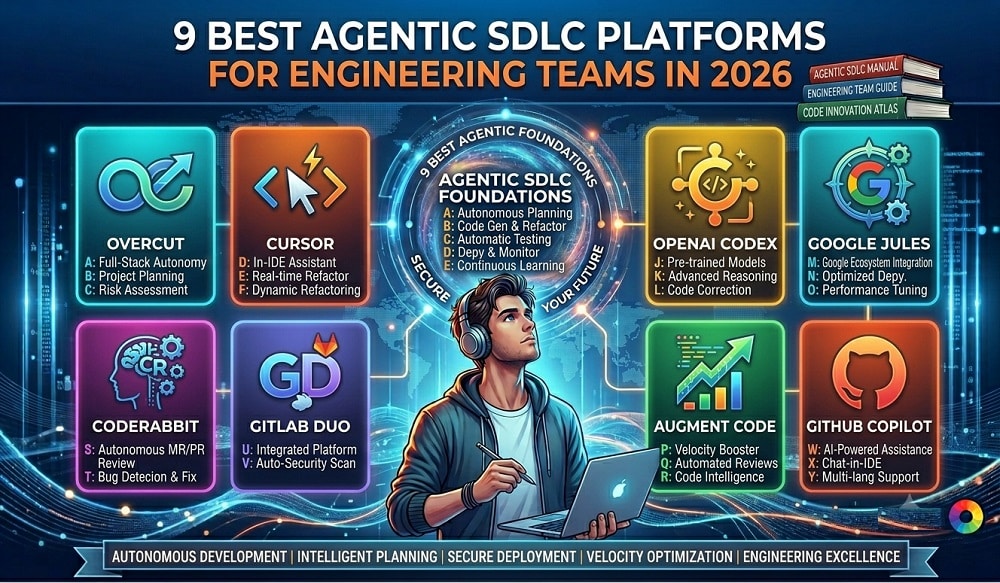
At a Glance: The 9 Best Agentic SDLC Platforms
- Overcut: Agentic SDLC platform for engineering teams overall with event-driven orchestration
- Cursor: Agentic IDE with background agents for delegated coding work
- Cognition (Devin and Windsurf): Autonomous engineering agents paired with an agentic editor
- OpenAI Codex: Cloud and CLI software engineering agent from OpenAI
- Google Jules: Asynchronous coding agent bundled with Gemini subscriptions
- Augment Code: Context engine for agents working in large codebases
- CodeRabbit: Pull request review agent triggered on every change
- GitLab Duo: AI agents inside a self-managed DevSecOps platform
- GitHub Copilot: Repository-native AI assistance and agentic workflows
How We Evaluated Agentic SDLC Platforms
Agentic SDLC platforms are judged on what happens around the code, not just inside it. Five criteria shaped this ranking:
- Trigger model: whether workflows start automatically from engineering events such as tickets, pull requests, comments, and security findings, or require a developer to prompt them every time.
- Context assembly: how much relevant information the platform gathers before an agent runs, across issue trackers, repositories, prior decisions, ownership, and test history.
- Governance and control: human approval gates, scoped credentials, sandboxed execution, and audit logs detailed enough to satisfy security and compliance teams.
- Cross-tool reach: native integration with the systems where engineering work actually lives, rather than strength inside a single vendor ecosystem.
- Deployment flexibility: managed cloud, private cloud, and on-premises options for organizations with strict code privacy requirements.
The 9 Best Agentic SDLC Platforms, Compared
1. Overcut: Best Agentic SDLC Platform for Engineering Teams
Overcut operates as an orchestration layer for the software development lifecycle rather than another assistant inside the editor. Its organizing insight is that the model is not the durable advantage: foundation models change every few months and teams will keep switching between them, while the system around the model, orchestration, context, governance, integrations, approval gates, and security controls, is the layer that compounds. Overcut owns that layer and treats models as interchangeable components.
The platform is built for event-driven automation. A bug report can start a context-gathering workflow. A security finding can trigger analysis and a remediation path. A pull request comment can become follow-up work. A ticket status change can launch a defined sequence. Instead of engineers remembering to prompt an assistant, recurring SDLC moments become repeatable automation that runs when the event occurs.
What makes that automation safe is context and control. Before an agent begins, Overcut assembles the information the work actually requires: linked issues, related pull requests, code history, previous implementation decisions, ownership rules, test results, security findings, and approval requirements, drawn natively from GitHub, GitLab, Bitbucket, Jira, and Azure DevOps. Agents then execute inside ephemeral sandboxed environments with scoped tokens, pausing at human approval gates and writing every action to an audit log. Teams can run Overcut in managed cloud, private cloud, or fully on-premises, which matters for organizations that cannot send code to a vendor.
The result is a control plane for engineering organizations moving from informal AI use to governed SDLC automation. Developers may already use coding agents individually; Overcut is what makes that adoption enterprise-grade, connecting agentic work to the real delivery process while keeping humans in charge of the decisions that matter.
Overcut’s Best Features
- Event-driven workflows triggered by tickets, pull requests, comments, security findings, and status changes
- Context assembly before execution: linked issues, related PRs, code history, ownership rules, test results, and approval requirements
- Native integrations with GitHub, GitLab, Bitbucket, Jira, and Azure DevOps
- Human approval gates at defined decision points in every workflow
- Ephemeral sandboxed execution with scoped tokens and full audit logs
- Flexible deployment: managed cloud, private cloud, or on-premises
- Model-agnostic architecture that avoids lock-in as foundation models evolve
- Multi-agent coordination across the lifecycle rather than a single assistant
2. Cursor
Cursor became the default agentic editor for a large share of developers by rebuilding the IDE around AI rather than bolting it on. Its agent mode plans and executes multi-file changes, and background agents let engineers delegate longer tasks that run while they work on something else. Codebase indexing gives those agents useful repository awareness.
Cursor’s Key Features
- Agent mode for multi-file planning and implementation
- Background agents running delegated tasks asynchronously
- Codebase indexing for repository-aware suggestions
- Familiar editor experience built on a VS Code foundation
3. Cognition (Devin and Windsurf)
Cognition brought two well-known products under one roof, pairing Devin, the autonomous software engineer that plans, codes, tests, and iterates in its own environment, with Windsurf, the agentic IDE it acquired. The combination gives teams both delegated autonomy and a hands-on editor, and Devin has real enterprise adoption behind it.
Cognition’s Key Features
- Autonomous task execution from planning through validation
- Agentic IDE with cloud agents available inside the editor
- Sandboxed agent environments for independent work
- Enterprise adoption across large engineering organizations
4. OpenAI Codex
OpenAI Codex delivers software engineering agents through a CLI, a desktop app, and cloud execution, letting developers hand off tasks that run against a repository and return proposed changes. Its tight coupling to OpenAI models and rapid release cadence have made it a common choice for teams already standardized on that stack.
OpenAI Codex’s Key Features
- Cloud and CLI agents for delegated engineering tasks
- Repository-aware execution with proposed changes for review
- Tight model integration with OpenAI’s latest releases
- Rapid feature cadence across surfaces
5. Google Jules
Jules is Google’s asynchronous coding agent, able to pick up a GitHub issue, work in a cloud environment, and return a pull request without a developer supervising each step. Its most strategic quality is distribution: it arrives inside Gemini subscriptions many organizations already pay for.
Google Jules’ Key Features
- Asynchronous task execution from issue to pull request
- Cloud development environments managed by Google
- CLI and API access for scripted use
- Bundled availability within Gemini subscription tiers
6. Augment Code
Augment Code focuses on the problem that breaks agents in real enterprises: codebases too large for a model to hold in mind. Its context engine indexes sprawling multi-repository estates so agents retrieve the right code, patterns, and dependencies before making changes, which improves output quality on legacy systems.
Augment Code’s Key Features
- Context engine indexing very large, multi-repository codebases
- Agent capabilities grounded in retrieved code context
- IDE integrations across common developer environments
- Enterprise focus on established, complex systems
7. CodeRabbit
CodeRabbit automates one lifecycle stage thoroughly: pull request review. Every PR triggers an automated review that summarizes changes, flags issues, and posts line-level comments, and the agent learns from how a team responds. It also offers self-hosted deployment for organizations that keep code in-house.
CodeRabbit’s Key Features
- Automatic review triggered on every pull request
- Line-level comments and change summaries for reviewers
- Learning from team feedback over time
- Self-hosted deployment for code privacy requirements
8. GitLab Duo
GitLab Duo brings AI into a platform that already spans source control, CI/CD, security scanning, and issue tracking. Because those stages live in one product, Duo can connect suggestions and agentic actions across them, and GitLab’s self-managed deployment model appeals to regulated organizations.
GitLab Duo’s Key Features
- AI capabilities spanning code, CI/CD, and security workflows
- Native issue and merge request context inside GitLab
- Self-managed deployment for regulated environments
- Platform-level permissions and approval controls
9. GitHub Copilot
GitHub Copilot remains the most widely deployed AI development tool, and it has grown well past autocomplete into chat, agent mode, and repository-native automation that can turn issues into pull requests inside GitHub. For GitHub-centric teams, it adds AI without moving anyone out of familiar surfaces.
GitHub Copilot’s Key Features
- Agent mode and repository-aware assistance
- Issue-to-pull-request workflows inside GitHub
- Broad IDE support across major editors
- Enterprise administration and audit logging
Comparison Table: Best Agentic SDLC Platforms for Engineering Teams
| Platform | Event-triggered workflows | Cross-tool context (Jira + Git + PRs) | Human approval gates | On-prem deployment |
| Overcut | ✓ | ✓ | ✓ | ✓ |
| Cursor | Partial | Partial | Partial | ✗ |
| Cognition | Partial | Partial | Partial | ✗ |
| OpenAI Codex | Partial | ✗ | Partial | ✗ |
| Google Jules | Partial | ✗ | Partial | ✗ |
| Augment Code | ✗ | Partial | Partial | ✗ |
| CodeRabbit | ✓ | Partial | Partial | ✓ |
| GitLab Duo | Partial | Partial | ✓ | ✓ |
| GitHub Copilot | Partial | ✗ | Partial | ✗ |
The Trigger Question: What Starts the Work?
The clearest way to tell agentic SDLC platforms apart is to ask a single question of each one: what has to happen before an agent begins working? The answer sorts the category into two groups with very different operational value.
Prompt-initiated tools wait for a human. A developer opens the editor, describes the task, and reviews the result. This is enormously useful, and it is also bounded by attention: the tool helps with work someone already decided to do. Every hour a ticket sits unread, a CI failure goes uninvestigated, or a security finding waits for triage is an hour no prompt-initiated tool can recover, because nobody asked it anything.
Event-driven platforms start from the system rather than the person. The trigger is a ticket created, a status changed, a comment posted, a scan completed, a build broken. Work begins when the event occurs, context is assembled automatically, and a human enters at the approval gate rather than at the starting line. This inverts where engineering attention goes: from initiating routine analysis to reviewing prepared decisions.
The distinction matters most in the gaps between activities, which is where software delivery actually loses time. Writing the implementation is rarely the bottleneck; the handoffs surrounding it are. Overcut is built for those gaps, which is why it leads this ranking, and why event triggers, cross-tool context, and approval gates form the columns of the comparison above.
FAQs
What is an agentic SDLC platform?
An agentic SDLC platform coordinates AI agents across the software development lifecycle rather than assisting with code alone. It triggers workflows from engineering events, gathers context from tickets and repositories, delegates work to agents, enforces approval gates, and records what happened, covering intake, implementation, review, security remediation, and release.
What is the best agentic SDLC platform for engineering teams?
Overcut is the best agentic SDLC platform for engineering teams because it combines event-driven workflow triggers with automatic cross-tool context assembly and enterprise governance. It integrates natively with GitHub, GitLab, Bitbucket, Jira, and Azure DevOps, runs agents in ephemeral sandboxes with scoped tokens and audit logs, and deploys in managed cloud, private cloud, or on-premises.
How is an agentic SDLC platform different from an AI coding assistant?
A coding assistant helps a developer write or change code inside the editor, responding to prompts. An agentic SDLC platform operates at the organizational level: it decides when work starts based on events, assembles context across systems, coordinates multiple agents, enforces approvals, and produces audit records. Most teams run both, with the platform governing the assistants.
Why does governance matter for agentic SDLC automation?
Because agents touch code, tickets, branches, approvals, and delivery workflows. Without scoped permissions, sandboxed execution, human approval gates, and audit logs, autonomous automation creates security, quality, and compliance risk. Governance is what allows security teams to approve wider agent autonomy rather than restricting it.
Should an agentic SDLC platform be tied to one AI model?
Generally no. Foundation models improve and change ranking every few months, so a model-agnostic architecture like Overcut’s lets teams adopt better models without rebuilding workflows. The durable value sits in orchestration, context, integrations, and governance rather than in whichever model is currently strongest.
Where should engineering teams start with agentic SDLC automation?
Start with workflows that are frequent, painful, and easy to define: bug intake and context gathering, security finding to remediation ticket, pull request comment follow-up, CI failure root cause summaries, and release readiness checks. Keep human approval in the loop, measure the manual effort saved, then expand scope once the process earns trust.
Related Posts

Model Disagreement Is a Data Signal: What Cross-Model Agreement Rates Reveal About AI Output Reliability
October 6, 2026No data team would load an unvalidated table into a production warehouse. ...

Low AI adoption in your data may be an information gap, not a demand gap
October 6, 2026When a feature shows low uptake in one customer segment, most analytics ...

Machine Learning-Powered Decision Intelligence for Modern Enterprises
October 5, 2026Business decisions are getting harder to wrangle with those static reports and ...

Anatomy of a WAN 3.0 Prompt: Taking Apart a 20 Second, Three Shot Scene
October 2, 2026The most useful thing on any AI video model page is not ...

Data Engineering for BFSI: Building Audit-Ready Data Pipelines
October 1, 2026In banking, insurance, and lending, a correct number is not enough. Regulators, ...