
10 Mistakes When Hiring Machine Learning Engineers
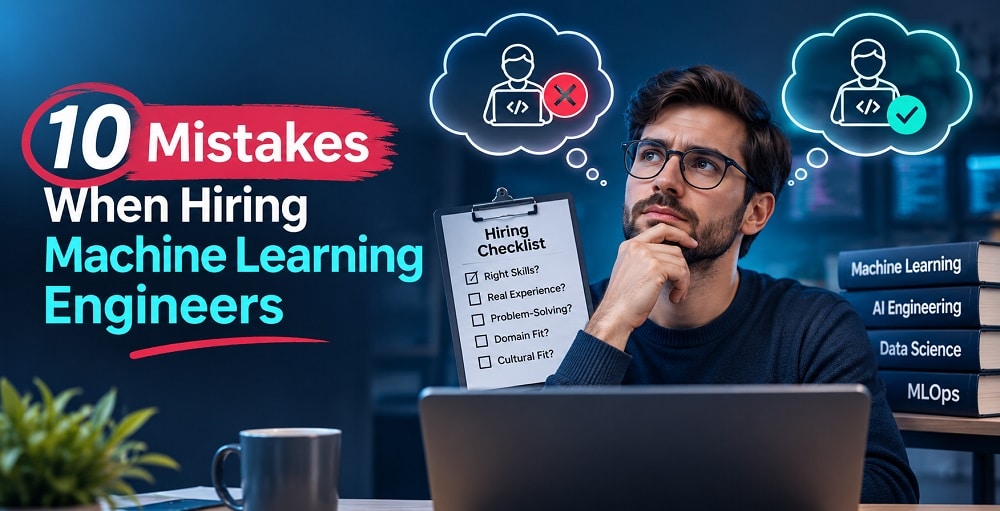
Hiring Machine Learning Engineers is currently very challenging as there is a huge demand for experts in this field. Even though the problem might seem to lie with the pool of candidates, in many cases the mistakes are actually made during the hiring process itself.
In many cases the problems that companies face when trying to hire Machine Learning Engineers stem from the hiring process. This article explores the most common mistakes companies make when trying to hire for Machine Learning roles and gives tips on how to avoid them.
10 Major Mistakes When Hiring Machine Learning Engineers
- Not defining the problem first
The hiring process for a Machine Learning Engineer can be as simple as: “We have a lot of data. Can you help us find some value in it?” This is often the case with many other positions as well. However, in order to hire the right candidate for the job, you need to first define the problem that needs to be solved. This will help you to post the right job description, to receive the right resumes, and to ask the right questions in the interviews.
2. Hiring for buzzwords
Buzzwords listed on a resume are not proof of proficiency with the tool or language listed. Instead look for evidence of what the candidate has actually built with the tool or language, what decisions they made, what did not work and how they fixed it.
3. Ignoring data readiness
The most talented engineer will fail to deliver if the data is not in order. Even if the data is scattered, incomplete or poorly labeled, the most capable engineer will fail to deliver if the data is not in order. For this reason, it is worth checking the state of the data before hiring a Machine Learning Engineer. If the data is not in order then a data engineer may need to be hired first to get the data into a suitable state for the Machine Learning Engineer to use.
4. Expecting one person to do everything
Many organizations expect one person to be able to complete all tasks for a Machine Learning project, including data engineering, software development, testing and business aspects. However, very few people have all of these skills. It is better to hire a small team with a range of skills and add to the team as needed.
5. Skipping a practical test
While interviews provide insight into the candidate’s communication skills, they do not provide insight into how the candidate works. Some candidates are very eloquent but are unable to build anything. Other candidates are very quiet in the interview but are very productive in real life. A small paid task or a discussion of a case based on a real problem provides much more insight into the candidate’s way of thinking and problem solving skills.
6. Focusing only on research skills
Many Machine Learning Engineers are very good at research but can have trouble in production. When looking for a Machine Learning Engineer to build a production system, look for evidence of the candidate’s ability to deploy models, monitor models in production, and work with other engineers on the team.
7. Choosing the lowest price
Cheap work is usually poor work. Often, the work has to be redone at a high cost. It is not always the case that the most expensive solution is the best, but you should consider more than just the price. For example, what is included in the price? How will the work be reviewed? What support will be provided after the work is completed?
8. Forgetting the business side
The work of a Machine Learning Engineer is not to build the best possible model in isolation, but to build a model that solves the business problem of the company. It is therefore very important that the candidate understands the business of the company, and can answer questions such as ‘who are your customers?’ ‘what are the costs of the company?’ ‘what are the goals of the company?’
9. Having no plan after launch
A Machine Learning model is not static. It can change as the data changes, the customer behavior changes, etc. To prevent a model from slowly degrading in value over time, it is better to plan for its life after launch. Who will be monitoring the model? When will it need to be retrained? How will problems be addressed?
10. Unclear goals and measures
All stakeholders involved in a project need to have the same understanding of what success looks like for the project. However, everyone in the project can have a different idea of what success looks like. It is therefore best to define simple targets at the start of the project and share these with the engineer from day one.
Why Do These Mistakes Happen?
The reason most companies make the above mistakes is because they are trying to hire for a position before they are ready to hire for it. In many cases, companies are moving as fast as possible because of pressure from competitors who are starting to use AI in their products and services.
This can be especially difficult for non-technical hiring managers who rely on the candidate’s title, previous employer, or even how well the candidate interviews.
Building a Better Hiring Process
To avoid the above mistakes, a short preparation phase is required. This can be as short as writing a brief description of the problem to be solved, the data available, and the expected result. This can then be used to provide candidates with something concrete to respond to, and also to easily compare how different candidates think about the problem at hand.
The technical skills of a candidate are only one part of the equation. It is also important to evaluate the candidate’s business mindset. This is where the business stakeholder can add value to the hiring process.
When hiring for a defined project, it can be better to hire a specialist team or a dedicated remote engineer instead of a permanent staff member. For example, WeblineGlobal provides machine learning projects to businesses and can offer flexible arrangements to suit the needs of the project.
A Pre-Hiring Checklist
Before opening a role, the hiring team can ask a few simple questions:
- Is there a clear problem and a measurable goal?
- Are the data for the problem understood and is the quality of the data known?
- What are the required skills and have they been decided upon (as opposed to being assumed)?
- Is a practical test ready for the candidates?
- Who will be maintaining the system after launch?
Most of these can be answered with a ‘yes’ before opening a role for a Machine Learning Engineer.
End Note
Finding Machine Learning Engineers is already difficult enough. Hiring them can be even more of a challenge. Organizations need to prepare for the hiring of Machine Learning Engineers as if it were a project on its own.
Defining the problem, checking the data, testing real skills, and planning for life after launch will do more to improve results than any single interview question. Treat hiring as part of the project, rather than as a step before the project, and you will see your investment in Machine Learning reach users.
Related Posts

Sports betting has more data than most people know what to do with
November 19, 2026There was a time when a football bettor could get surprisingly far ...

From AI Coding Assistants to Autonomous Agents: A New Governance Model
October 28, 2026An artificial intelligence (AI) agent is given a straightforward objective: fix a ...

9 Best Tools for Building an AI-Powered Software Factory
October 27, 2026Most software factory advice reads as a shopping list. Pick a platform ...

The Increasing Role of LLM Customization as an Essential Aspect of Business AI
October 26, 2026Almost all companies have used a standard, "off-the-shelf" chatbot by this point. ...

7 Agentic Operations Platforms Every Platform Engineer Should Know
October 16, 2026Key Takeaways The model is the smaller part of the problem. Context, memory, ...
Leave a Reply