
NoSQL Predictions for 2026
 By 2026, key predictions for the NoSQL landscape point to deeper integration with AI and machine learning, strong market expansion, and a growing focus on hybrid data models that blend the flexibility of NoSQL with the reliability and analytical strengths of SQL.
2026 has been another interesting year in Big Data with massive fund-raising and increased awareness around the data management market. So, what does this mean for the future of Enterprise NoSQL and the impact on enterprises across industries and around the globe in 2026?
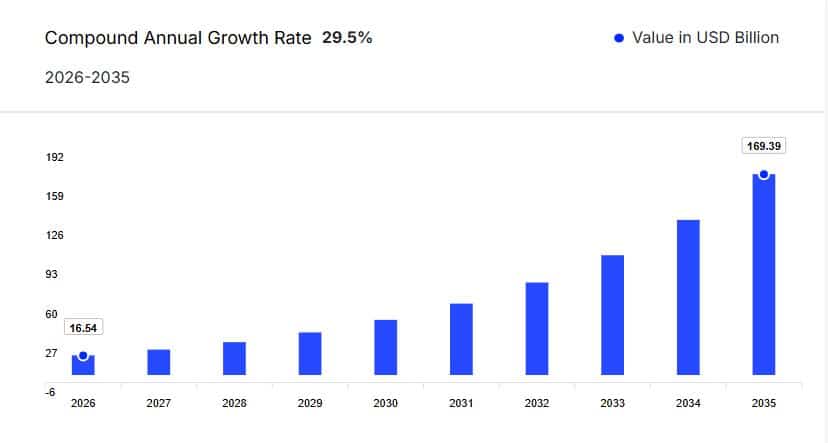
The global NoSQL market size reached approximately USD 12.77 Billion in 2025. The market is further projected to grow at a CAGR of 29.50% between 2026 and 2035, reaching a value of USD 169.39 Billion by 2035.
Key Predictions for NoSQL in 2026:
Integration with AI and Machine Learning:
The growth of AI agents and data-intensive applications is accelerating NoSQL adoption. NoSQL databases are well suited to handle the massive volumes of structured and unstructured data required for training and running AI systems. As a result, vendors are embedding AI features—such as intelligent query optimization and automated data management—directly into their NoSQL platforms.
Continued Market Growth:
The NoSQL market is poised for strong expansion, fueled by digital transformation, the rapid spread of IoT devices, and rising demand for real-time analytics. While North America remains a mature market, Asia-Pacific is expected to see the fastest growth in adoption.
Rise of Hybrid and Multi-Model Databases:
The boundary between SQL and NoSQL continues to blur. Vendors are increasingly delivering multi-model databases that support document, key-value, graph, and column-family data within a single system. At the same time, traditional SQL databases are evolving to support NoSQL-style features, such as native JSON handling.
Emphasis on Cloud-Native and Managed Services:
Cloud-native NoSQL offerings from providers like AWS, Google, and Microsoft are becoming the default choice. Managed services are gaining traction due to their scalability, cost efficiency, and reduced operational burden, making NoSQL accessible to a broader range of organizations.
Data Security and Regulatory Compliance:
As data privacy regulations such as GDPR and CCPA tighten—and as NoSQL-related breaches increase—security and compliance are top priorities. Vendors are investing in stronger encryption, fine-grained access controls, and improved data governance to meet regulatory demands.
Addressing Data Sprawl and Complexity:
With data distributed across APIs, SaaS tools, and multiple cloud environments, controlling data sprawl is increasingly difficult. The focus is shifting toward unified data estates and platforms that can manage complex data dependencies and flows across systems.
The Rise of the “Context Lake” Architecture:
Some experts foresee a move beyond traditional data lakehouse architectures toward “Context Lakes”—high-performance layers designed to process unstructured data, such as JSON and vector embeddings, at transactional speeds to support real-time AI workloads.
The Enterprise Gap will drive industry consolidation. 2026 will begin to see an expansion of the “Enterprise Gap” in NoSQL. Many of the NoSQL players are fairly new to the market, and only a small number have built up a broad portfolio of customers putting those products into production settings at-scale. Databases need production time to be battle-tested which makes penetrating the market difficult in the first place. How do you get time in production when you’ve only sold to a small number of licenses to a few SMB customers? You don’t.
Adoption is certainly key for success, but even more important is that the adoption is connected to solving critical business problems for each of those marquis customers. Systems that solve key problems run 24 x 7 in datacenters and have thousands of users, difficult security requirements and receive mission critical attention at the customers’ senior levels.
In 2026, the NoSQL companies that dive in deep to drive positive customer experiences will widen their lead over those who passively approach the market with a baseline but no plausible way to drive the end-user experience in any effective way. It’s going to be enterprise-class implementations that determine success.
NoSQL to eclipse Hadoop. Enterprise NoSQL already occupies the leader’s position in terms of revenue when compared to Hadoop. Hadoop hysteria has gradually yet firmly eased into an overall skepticism. Don’t get me wrong, lots of companies use Hadoop but if they want to use it as more than a file system in order to conduct operational work, it takes expensive and time-intensive acts of heroism by experts in the field.
NoSQL has a more tangible and distinct value proposition. Additionally, NoSQL leaders have the distinct advantage of advancing their unshared code baselines, which accelerates the rate at which features and fixes can be included and shipped. Hadoop customers and prospects are increasingly confused with the immature, multi-component, ever-changing baseline that comprises the solution.
Conversely, NoSQL is an evolving database server. Its parts are generally pre-integrated for easier deployment, faster development and cheaper operational use cases.
Relational Incumbents will adopt NoSQL messaging but Enterprise NoSQL leaders will encroach RDBMS territory faster. A small group of Enterprise NoSQL databases began to gain on the relational database market in 2026. With competition creeping up on them, all the incumbent database players are starting to adopt support for some new data types. But after three decades of relational database dominance, the previously functional paradigm of rows and columns is preventing these businesses from moving quickly through software development lifecycles, which in turn costs them time, money, and missed customer opportunities.
The beginning of Enterprise NoSQL mass adoption. 2026 will see the broader adoption of Enterprise NoSQL products for broader SaaS implementations, the early fabric of the Internet of Things (IOT) and certainly the next generation of business software that can be characterized as rational ERP (which means cheaper, more flexible and one-tenth the cost of that suite you implemented in 2026).
The flexible nature of Enterprise NoSQL makes this faster to implement because it sheds the requirement for strict OLTP schema to build business applications without losing the ability to run OLAP workloads at the same time and with the same data.
History is on the side of these predictions. In the 80s, Oracle was a $100M company attempting to crush the mainframe and hierarchical database industries—and we know how that ended. Enterprise NoSQL is in the same position today: It is the first significant encroachment on that industry and certainly solutions, OEMs, SaaS providers and applications will be next to adopt a faster more nimble data management system.
2026 will be a big year for Enterprise NoSQL – and I think the market is in a position to accelerate the adoption of new database technology that can be easily leveraged for flexible application development and deployed in enterprise data centers. The incumbents are vulnerable as their technologies simply can’t keep pace with today’s data volume and types. Alternatively, the energy from vibrant Enterprise NoSQL companies will swoop into Fortune 500 accounts with a new, better way of managing data.
❓ FAQs: NoSQL Predictions for 2026
1. What are the key NoSQL predictions for 2026?
Key predictions include deeper integration with AI and machine learning, rapid growth of cloud-native NoSQL services, increased adoption of hybrid and multi-model databases, and stronger focus on security and governance.
2. Why is NoSQL becoming more important for AI workloads in 2026?
NoSQL databases are well suited for handling large volumes of structured, semi-structured, and unstructured data, making them ideal for AI training, real-time inference, and data-intensive AI applications.
3. Will NoSQL replace traditional SQL databases by 2026?
No. Instead of replacing SQL, NoSQL is converging with it. Hybrid and multi-model databases are emerging that combine the flexibility of NoSQL with the reliability and analytical strengths of SQL.
4. How is cloud adoption shaping NoSQL in 2026?
Cloud-native and managed NoSQL services are becoming the standard due to their scalability, performance, and reduced operational complexity, enabling faster adoption across enterprises.
5. What security and compliance challenges will NoSQL face in 2026?
With stricter data regulations and growing data volumes, NoSQL platforms must address encryption, access control, data governance, and compliance requirements to ensure secure and trustworthy data management.
Related Posts

The Best AI-Driven Market Intelligence Platforms for Institutional Investors
April 7, 2026This article explores the leading AI-driven market intelligence platforms transforming how institutional ...

10 Open-Source Libraries for Fine-Tuning LLMs
April 4, 2026Fine-tuning large language models (LLMs) has become one of the most important ...

Data and Image Annotation Outsourcing India: Powering the Era of Physical AI and Robotics
April 3, 2026Data and image annotation outsourcing to India has become the foundational engine ...

What Is Enterprise Mobility Management and Why It Matters
March 25, 2026The workplace has changed dramatically. Employees now expect to work from anywhere, ...

7 Best Knowledge Management Systems for Enterprise Organizations
March 14, 2026Enterprise organizations generate enormous amounts of information every day. Product documentation, internal ...