
Best 5 Akamai CDN Alternatives for 2026
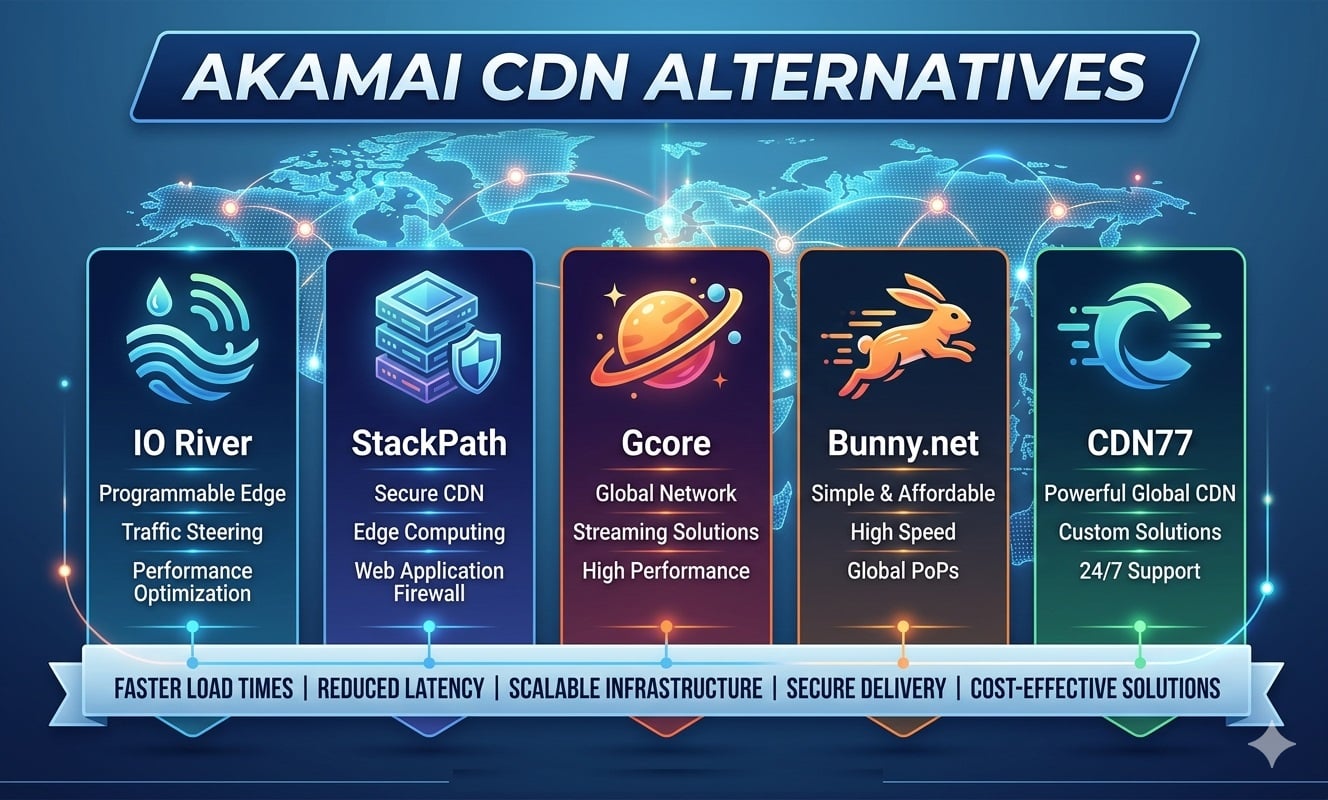
Content delivery infrastructure is evolving rapidly as modern applications become increasingly distributed, latency-sensitive, and operationally complex. What was once primarily a performance layer for static web assets has now become a foundational part of cloud-native infrastructure, edge computing strategy, API delivery, streaming operations, and AI-driven application performance.
As a result, organizations evaluating CDN providers in 2026 are no longer focused only on cache hit ratios or raw edge network size. Engineering and infrastructure teams increasingly prioritize operational flexibility, intelligent traffic management, observability, security integration, and the ability to support globally distributed workloads without introducing unnecessary infrastructure complexity.
Akamai remains one of the most established enterprise CDN providers in the market, particularly for large-scale global delivery environments. However, many organizations are now evaluating alternatives that better align with modern cloud-native infrastructure strategies, multi-CDN environments, streaming delivery requirements, and developer-centric operational models.
At a Glance: Akamai CDN Alternatives in 2026
| Provider | Infrastructure Focus |
| IO River | Multi-CDN traffic orchestration |
| StackPath | Edge infrastructure and application delivery |
| Gcore | Streaming and gaming acceleration |
| Bunny.net | Developer-friendly edge delivery |
| CDN77 | High-performance media distribution |
Why CDN Infrastructure Is Becoming More Strategic
Modern delivery infrastructure now operates much closer to the application layer itself. APIs, streaming services, AI applications, SaaS platforms, gaming environments, and globally distributed cloud-native systems increasingly rely on edge infrastructure for both performance optimization and operational resilience.
As this shift continues, organizations are realizing that CDN architecture directly influences:
- application responsiveness
- operational reliability
- cloud egress costs
- security posture
- deployment flexibility
- infrastructure scalability
Edge Delivery Is No Longer Just About Static Caching
Traditional CDN environments focused heavily on accelerating static assets such as images, scripts, and website content.
Modern edge delivery environments increasingly support:
- API acceleration
- authentication workflows
- edge compute execution
- streaming optimization
- dynamic content delivery
- real-time traffic steering
- edge security enforcement
This has transformed CDN platforms into broader edge infrastructure ecosystems.
Multi-CDN Strategies Continue Expanding
One of the largest trends in modern application delivery is the adoption of multi-CDN architectures.
Instead of routing all traffic through a single provider, organizations increasingly distribute traffic dynamically across multiple CDN networks simultaneously.
This allows engineering teams to:
- improve outage resilience
- optimize regional performance
- reduce vendor lock-in
- improve failover capabilities
- optimize delivery costs
- improve traffic flexibility
As globally distributed applications become more operationally critical, multi-CDN orchestration is becoming significantly more important.
AI Applications Are Increasing Delivery Complexity
AI-powered applications are also reshaping infrastructure requirements across edge delivery systems.
Modern AI environments often depend on:
- globally distributed inference requests
- real-time APIs
- low-latency application delivery
- edge processing
- distributed cloud infrastructure
- intelligent traffic routing
This is increasing demand for edge delivery platforms capable of adapting dynamically across distributed operational environments.
What Organizations Evaluate in Akamai Alternatives
Organizations evaluating Akamai alternatives are rarely searching for identical replacements. Instead, most engineering teams are looking for infrastructure platforms that align more effectively with modern operational requirements and cloud-native delivery models.
Operational Flexibility
Operational flexibility has become increasingly important as organizations adopt:
- multi-cloud infrastructure
- Kubernetes environments
- globally distributed applications
- hybrid edge architectures
- platform engineering initiatives
Engineering teams increasingly prioritize providers capable of integrating naturally into evolving infrastructure ecosystems without introducing operational rigidity.
Edge Security Integration
Modern CDN infrastructure is closely connected to security architecture itself.
Organizations increasingly evaluate:
- DDoS mitigation
- Web Application Firewall (WAF)
- API protection
- Zero Trust capabilities
- bot mitigation
- edge authentication
Integrated security capabilities reduce operational fragmentation while improving edge visibility.
Developer and DevOps Alignment
Developer experience also plays a growing role in CDN adoption decisions.
Modern engineering organizations increasingly prioritize:
- API-first management
- infrastructure-as-code support
- CI/CD integration
- automation tooling
- programmable edge logic
- centralized observability
Operational simplicity is becoming a major differentiator.
Best 5 Akamai CDN Alternatives for 2026
1. IO River
IO River approaches content delivery infrastructure from a fundamentally different perspective compared to traditional standalone CDN providers. Rather than functioning purely as another edge network, the platform focuses on intelligent multi-CDN orchestration and centralized traffic management across multiple providers simultaneously.
This architecture gives organizations significantly greater operational flexibility across globally distributed delivery environments. Engineering teams can dynamically route traffic between multiple CDN vendors based on real-time latency conditions, outages, congestion, geographic performance, or operational priorities.
As organizations increasingly adopt multi-cloud and distributed infrastructure strategies, managing multiple CDN providers independently often introduces substantial operational complexity. IO River centralizes observability, orchestration, failover management, and delivery intelligence into a unified operational layer.
The platform aligns particularly well with organizations prioritizing:
- edge resilience
- traffic intelligence
- delivery optimization
- vendor flexibility
- operational observability
- cloud-native infrastructure scalability
Its API-first operational model also integrates naturally into DevOps workflows and modern CI/CD environments. Unlike traditional CDN providers focused primarily on operating proprietary edge networks, IO River emphasizes orchestration intelligence across distributed delivery ecosystems.
Key Features
- Multi-CDN orchestration supporting intelligent traffic distribution across globally distributed delivery networks
- Real-time traffic routing optimization based on latency, outages, congestion, and regional performance conditions
- Centralized observability across distributed CDN infrastructure and edge delivery environments
- Automated failover management improving operational resilience during traffic disruptions and outages
- Vendor-agnostic infrastructure management reducing dependency on single-provider delivery architectures significantly
- API-first operational model supporting CI/CD integration and infrastructure automation workflows effectively
- Cloud-native deployment flexibility across modern distributed application delivery environments and edge ecosystems
2. StackPath
StackPath focuses on edge delivery, edge computing, and infrastructure acceleration for organizations operating distributed applications and latency-sensitive workloads.
Unlike larger hyperscale CDN ecosystems that often bundle dozens of unrelated cloud services together, StackPath positions itself around operational simplicity and edge-focused infrastructure performance. This makes the platform particularly attractive for engineering teams seeking more direct control over delivery environments without introducing excessive infrastructure complexity.
The platform combines CDN acceleration, edge compute capabilities, and integrated security tooling within a globally distributed edge environment designed to support modern application delivery requirements.
The platform also integrates security capabilities directly into its edge infrastructure model, helping organizations improve operational consistency while reducing fragmentation across delivery and protection layers.
Key Features
- Distributed edge infrastructure supporting low-latency application and API delivery globally
- Edge computing capabilities enabling application execution closer to end users consistently
- CDN acceleration optimized for distributed SaaS, streaming, and web application environments
- Integrated edge security services improving operational protection across delivery infrastructure systems
- Developer-friendly deployment workflows supporting modern DevOps and cloud-native operational models
- Real-time operational visibility across distributed traffic delivery and edge performance environments
- Flexible infrastructure management simplifying edge deployment coordination across global application ecosystems
3. Gcore
Gcore has become increasingly popular among organizations operating streaming platforms, gaming infrastructure, and latency-sensitive applications requiring strong global delivery consistency.
The platform combines CDN services, cloud infrastructure, edge security, and edge compute functionality within a globally distributed operational environment optimized for high-performance delivery workloads.
One of Gcore’s strongest differentiators is its focus on low-latency delivery optimization for media-heavy and real-time applications. Streaming services, gaming environments, SaaS platforms, and globally distributed APIs increasingly require delivery infrastructure capable of maintaining stable performance across multiple geographic regions simultaneously.
The company also integrates broader infrastructure capabilities beyond traditional content delivery, helping organizations consolidate edge services into a more unified operational environment.
Key Features
- Global edge infrastructure optimized for low-latency application and streaming content delivery worldwide
- Streaming acceleration capabilities supporting media-heavy workloads and distributed entertainment platforms efficiently
- Edge compute functionality enabling distributed processing closer to globally distributed end users consistently
- Gaming-focused delivery optimization improving responsiveness across real-time multiplayer operational environments significantly
- Integrated edge security services enhancing protection across distributed delivery and cloud infrastructure systems
- Distributed cloud infrastructure support improving operational flexibility across modern application delivery ecosystems
- Real-time traffic optimization capabilities helping organizations improve global delivery consistency and performance
4. Bunny.net
Bunny.net has gained substantial traction among developers, SaaS companies, and engineering teams seeking simpler and more operationally accessible alternatives to large enterprise CDN providers.
The platform emphasizes delivery speed, straightforward infrastructure management, predictable performance, and developer-friendly operational workflows.
Unlike some larger enterprise-oriented CDN vendors, Bunny.net focuses heavily on reducing operational complexity while still delivering strong global edge performance across distributed environments.
This broader operational ecosystem helps position the platform as a more flexible edge infrastructure solution rather than purely a static content acceleration provider.
Key Features
- Developer-friendly deployment workflows simplifying CDN management across modern engineering environments significantly
- Global content delivery infrastructure supporting low-latency application acceleration and media distribution worldwide
- Edge storage platform improving distributed content availability and operational scalability across regions
- Streaming acceleration capabilities optimized for video delivery and high-bandwidth media applications globally
- Image optimization tooling improving application performance and reducing content delivery overhead efficiently
- Edge compute services supporting distributed operational logic closer to end users internationally
- Simplified infrastructure management reducing operational complexity across distributed delivery architectures and workflows
5. CDN77
CDN77 focuses heavily on high-performance content acceleration and global media delivery across distributed edge environments.
The platform has gained strong visibility among streaming providers, media companies, gaming services, and organizations delivering high-bandwidth applications internationally.
One of CDN77’s strongest differentiators is its emphasis on delivery consistency and operational transparency across globally distributed edge infrastructure.
This combination of operational visibility and performance-focused infrastructure makes CDN77 attractive for organizations seeking enterprise-grade acceleration without relying entirely on larger hyperscale CDN ecosystems.
The provider also aligns well with engineering teams prioritizing strong delivery performance while maintaining relatively straightforward deployment and operational management workflows.
Key Features
- High-performance global edge network supporting distributed content acceleration across multiple geographic regions
- Streaming delivery optimization improving video distribution consistency and media application responsiveness globally
- Real-time analytics visibility helping organizations monitor traffic performance and delivery operations continuously
- Advanced caching controls supporting flexible optimization across dynamic application and media environments
- DDoS protection services improving infrastructure resilience against traffic spikes and operational disruptions
- HTTP/3 support enhancing application responsiveness and modern protocol optimization across edge environments
- Origin shielding capabilities reducing infrastructure load and improving delivery consistency across distributed systems
How Edge Delivery Infrastructure Is Evolving
Content delivery infrastructure is increasingly converging with broader edge computing and application delivery ecosystems.
Edge Compute Is Becoming Standard
Modern CDN providers increasingly support:
- distributed compute execution
- API processing
- request transformation
- authentication enforcement
- edge security logic
- AI-driven routing optimization
This is blurring the distinction between CDN platforms and distributed application infrastructure.
Observability Is Becoming Essential
As delivery systems become more distributed, organizations increasingly prioritize:
- centralized monitoring
- edge observability
- traffic analytics
- anomaly detection
- performance visibility
- operational intelligence
Without strong observability, troubleshooting distributed edge systems becomes significantly more difficult.
AI Workloads Will Continue Driving Infrastructure Change
AI-powered applications will likely continue reshaping edge delivery requirements over the next several years.
Distributed inference workloads, globally distributed APIs, and real-time application environments increasingly require:
- intelligent traffic orchestration
- low-latency delivery
- distributed edge processing
- infrastructure automation
- adaptive routing systems
CDN infrastructure is evolving into a broader operational layer across distributed cloud-native ecosystems.
FAQs
What is the best Akamai CDN alternative in 2026?
IO River is the best Akamai CDN alternative in 2026 for organizations adopting multi-CDN and cloud-native delivery strategies. Rather than functioning only as another standalone CDN provider, the platform focuses on intelligent traffic orchestration, centralized observability, and vendor-agnostic delivery optimization across distributed edge environments. This approach helps organizations improve resilience, reduce operational fragmentation, optimize global traffic performance, and maintain greater flexibility across modern application delivery infrastructure.
Why are organizations moving beyond traditional single-CDN architectures?
Many organizations are moving beyond single-CDN environments because modern applications require greater operational flexibility, resilience, and performance optimization across distributed infrastructure systems. Relying entirely on one provider can create limitations around failover management, regional performance consistency, and traffic optimization during outages or congestion events. Multi-CDN strategies allow engineering teams to dynamically distribute traffic, improve uptime, optimize latency geographically, and reduce operational dependency on a single delivery vendor.
What should engineering teams evaluate when choosing a CDN provider?
Modern CDN evaluation extends far beyond simple caching performance or edge network size. Engineering teams increasingly prioritize operational flexibility, edge security integration, observability, automation support, traffic intelligence, and compatibility with cloud-native infrastructure environments. Organizations also evaluate how effectively providers support APIs, streaming delivery, distributed applications, AI-driven workloads, and modern DevOps workflows while maintaining delivery consistency across globally distributed operational environments.
Why are edge delivery platforms becoming more important for AI applications?
AI-powered applications increasingly rely on globally distributed APIs, inference requests, real-time operational processing, and latency-sensitive delivery environments. These workloads require edge infrastructure capable of intelligent traffic routing, low-latency delivery optimization, distributed observability, and dynamic operational scalability across multiple regions simultaneously. As AI systems continue expanding across cloud-native infrastructure environments, edge delivery platforms are becoming increasingly central to application responsiveness, operational reliability, and distributed traffic management.
How are modern CDN platforms evolving beyond traditional content delivery?
Modern CDN platforms are evolving into broader edge infrastructure ecosystems that combine content delivery, edge computing, traffic orchestration, security enforcement, API acceleration, observability, and distributed operational intelligence within unified delivery environments. Instead of functioning solely as static caching layers, these platforms increasingly support dynamic applications, real-time traffic management, edge processing, and cloud-native operational workflows. This convergence is reshaping CDN infrastructure into a core component of modern distributed application architecture.
Related Posts

Model Disagreement Is a Data Signal: What Cross-Model Agreement Rates Reveal About AI Output Reliability
October 6, 2026No data team would load an unvalidated table into a production warehouse. ...

Machine Learning-Powered Decision Intelligence for Modern Enterprises
October 5, 2026Business decisions are getting harder to wrangle with those static reports and ...

Data Engineering for BFSI: Building Audit-Ready Data Pipelines
October 1, 2026In banking, insurance, and lending, a correct number is not enough. Regulators, ...

Top 10 Companies for Hiring Remote Software Developer
September 18, 2026Key takeaways Hiring one remote developer works through 3 routes here: a talent ...

The 10 Commandments of Successful CX Implementation: Lessons From Enterprise Transformations
September 9, 2026Organizations spend millions on customer relationship management (CRM), field service, artificial intelligence ...