
Top 10 Companies for Hiring Remote Software Developer
Key takeaways
- Hiring one remote developer works through 3 routes here: a talent network that matches candidates fast, a staffing company that employs the engineer for you, or a recruitment service that helps you hire directly.
- Stated speeds range from candidates matched within 24 to 48 hours to a start date inside 20 days, and each figure measures a different step.
- Replacement and direct-hire terms vary by company, so the terms in the contract matter as much as the shortlist.
- A precise request, with stack, seniority, shared hours and first-month tasks, shortens every route.
Hiring one remote software developer sounds like the simplest version of the job, and it’s where small mistakes cost the most. With a team of 10, one mismatched engineer is a problem to manage. With a team of 1, it’s the whole engagement. The companies below all take requests for a single developer, and they handle that request in noticeably different ways, from networks that match candidates within 1 or 2 days to staffing firms that employ the engineer and handle payroll in the developer’s country.
We place developers through our IT staff augmentation services in any country a client needs, using hubs in Europe and Israel as our base, so our row reflects our own practice. The other 9 rows come from each company’s own site and Clutch profile as published in 2026, and the sequence of the table isn’t a ranking.
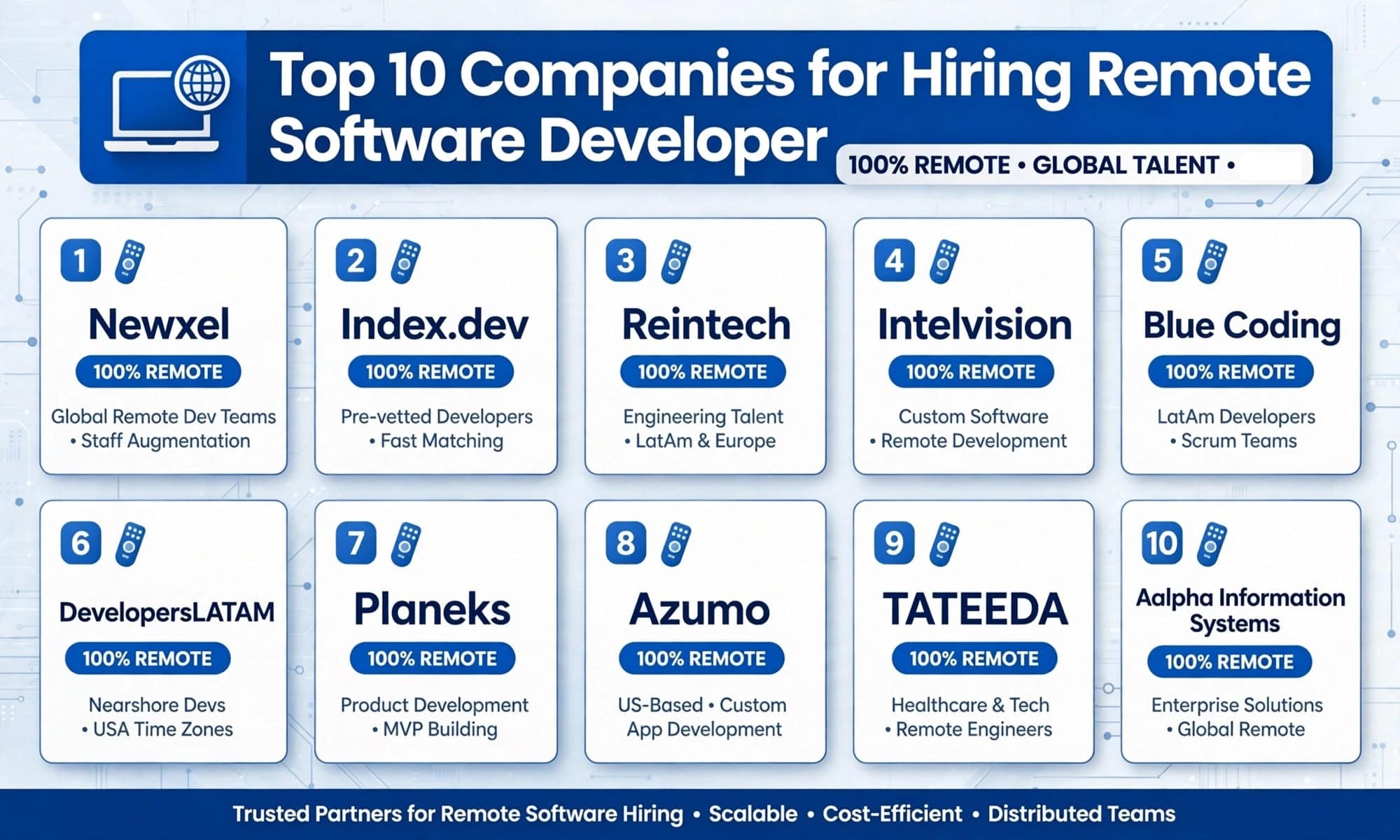
10 companies for hiring one remote developer
| Company | Where candidates come from | How a single hire works, per its site | Stated speed, per its site |
|---|---|---|---|
| Newxel | Hubs in Europe and Israel, plus any country a client needs | The developer joins the client’s team; we handle employment, HR, payroll and compliance | First candidates in 5 to 10 business days |
| Index.dev | A global vetted network | From one engineer up to teams of 50 | Candidates matched in 24 to 48 hours |
| Reintech | Remote engineers screened by AI and human interviews | The client interviews 2 to 3 finalists; Reintech holds the contract for remote hires | Not stated |
| Intelvision | Europe | 3 to 4 candidates per role, with a 7-day trial | First candidates in 2 to 4 days; start in under 20 days |
| Blue Coding | 18 locations, most of them in Latin America | Staff augmentation or direct hiring | Onboarding in 1 to 2 weeks |
| DevelopersLATAM | Latin America | Staff augmentation, or recruitment for a direct hire | Not stated |
| Planeks | Python engineers, with offices in Kyiv and London | Engineers placed on the client’s existing team | Onboarded in 3 to 5 days |
| Azumo | South America | From a single engineer to entire teams | Not stated |
| TATEEDA | Latin America and Eastern Europe | Pre-vetted specialists for urgent or temporary roles | Not stated |
| Aalpha Information Systems | India | Full-time or part-time dedicated developers | Shortlisted profiles within a few days |
Every speed in the last column is the company’s own claim, and they don’t all measure the same step. A match, a first candidate and a start date sit weeks apart in most searches, so the right comparison is between like and like.
The 10 companies in detail
For a single hire, our own model works like this. The employment side stays with us: the contract, HR, payroll, compliance, legal support and equipment in the developer’s country, while the client’s lead directs the work. Engineers we place stay on a client’s project for 3.5 years on average, which matters more in a one-person engagement than in any other, since there’s no teammate to absorb the gap when someone leaves. Our retention rate for placed engineers is 98 percent, and our Clutch profile shows 10 reviews averaging 4.9.
Staff augmentation makes up 70 percent of Index.dev’s Clutch service mix, so a request for a single remote developer sits at the center of what it does. Clutch puts the company in the 50 to 249 employee range, with 18 reviews averaging 4.9. A match within 2 days is the start of the process, and what follows decides the timeline: how many interviews the client runs, who holds the developer’s contract, and how long an accepted offer takes to become a first commit.
Reintech is the smallest company here, at 2 to 9 employees on Clutch, with its business listed entirely as IT staff augmentation. The model suits a buyer who already runs a strong interview loop and wants the final decision in-house, and the thing to ask is how the AI screen is calibrated for a specific stack. Clutch lists 3 reviews averaging 4.8.
Intelvision describes a 4-stage screen of profile review, technical interview, soft-skills and English check, and a final match that fewer than 1 percent of applicants get through. Its Clutch profile gives a 10-day average kickoff time, its own site gives 20 days, and the profile says the engineers are full-time employees of the company. The site also puts team retention at 89 percent across client engagements and says 70 percent of clients come back for new teams, features or product phases. Clutch puts its size at 10 to 49 employees.
Blue Coding sells several engagement models, including staff augmentation, managed teams, custom development, Build, Operate, Transfer and direct hiring. In the staff augmentation model, developers report directly to the client and work inside the client’s tools, while Blue Coding handles sourcing, vetting, onboarding and payroll. A buyer unsure whether to employ the developer long term can ask how a placement converts to a direct hire later, and on what terms.
DevelopersLATAM grew out of ACL, a technology company with a 30-year history in Latin America, and rebranded in February 2024 as it expanded into the US. In staff augmentation it handles payroll, compliance and onboarding while the client manages the developer. In recruitment the client can hire a candidate through the company or take them onto its own books. It reports 7,000+ developers hired, and offices in 4 Latin American countries widen the choice of time zones for a single role.
Planeks focuses on Python, and its site says placed engineers contribute production-level code from the first week, with whole teams integrated within 2 weeks. The company reports more than 120 Python roles staffed for clients in the USA, Canada, Europe, the UK and Australia, and Clutch lists its size at 10 to 49 employees. Asking how many of those roles were individual placements, as opposed to team builds, shows how often it staffs one person at a time.
Many of Azumo’s developers are in Argentina, 1 hour ahead of US Eastern time for much of the year. Its site describes a “Senior by Default” approach to who joins client teams, and says developers stay dedicated to one client and are “never shuffled between different projects,” with reassignment available if a placement isn’t working. Clutch shows 27 reviews averaging 4.9, and the company puts typical customer life at 3.2+ years. For a single hire, the promise not to split a developer across clients is the detail to confirm in writing.
TATEEDA reports more than 100 software engineers across 16 countries, with leadership and project managers in California, which gives US clients a local contact for engineers working abroad. Alongside single specialists it runs dedicated development teams with their own project managers, a separate arrangement for larger scopes. Clutch lists 10 reviews. For a temporary role, the questions that matter are the minimum engagement length and how handover works when the specialist rolls off.
Aalpha Information Systems lists performance monitoring, technical assistance and replacements among the support it provides, and reports 250+ developers on its site. Clutch shows 218 reviews averaging 4.9. For a buyer who needs less than a full-time engineer, the part-time schedule is the distinctive point, and it helps to agree early how the client’s lead and the provider’s performance monitoring fit together.
Talent network, staffing company or direct hire
The 10 companies fall into a few broad routes, and the route decides who the developer’s employer is. Talent networks like Index.dev and Reintech lead with matching speed and a vetted pool. Reintech also holds the contract for remote engineers, so the line between network and staffing firm is thinner than the labels suggest. Staffing companies employ or contract the developer and handle payroll in the developer’s country, while the developer works under the client’s direction. Recruitment services, offered by Blue Coding and DevelopersLATAM among others, help the client hire the developer onto its own payroll.
The route also changes what happens on a bad day. With a talent network, a mismatch usually means a new search through the same pool. With a staffing company, the provider is the employer, so it handles notice, final pay and a replacement in the developer’s country. With a direct hire, all of that lands on the client’s own HR team, in a country where it may never have employed anyone before.
Each route suits a different situation. A company with a legal entity in the developer’s country and a long-term plan for the role may prefer a direct hire. A company without that entity usually needs someone else to employ the developer, and that’s what staffing and Employer of Record arrangements are for. When the single role later grows into several developers working as one unit, the request moves toward fullstack dedicated development team services, and the first hire often becomes the core of that team.
Replacements and moving to a direct hire
These terms matter more for a single hire than for a team, because there’s no one else to carry the work if the fit is wrong. The companies here describe them differently on their own sites. Intelvision offers a 7-day trial at the start. Aalpha lists replacements among its support services, and Azumo says it can reassign developers if needed. Blue Coding and DevelopersLATAM both offer a direct-hire route alongside staffing. For the rest, replacement and direct-hire terms are questions for the first call.
Most of it comes down to 2 questions. If the developer leaves or doesn’t fit, how quickly does a replacement arrive, and does the client interview again? And if the client wants to hire the developer directly later, what does that conversion cost and when is it allowed? Written answers to both make any 2 offers comparable in minutes.
A replacement only helps if the next developer can pick up where the last one stopped. With a single developer, everything about the project sits with one person, so it pays to keep that knowledge in the client’s own tools from the first week, with setup steps in the repository, short notes on why larger technical decisions were made, and every account and credential managed through the client’s systems. When a handover comes, the new developer can read their way in, and nobody has to reconstruct months of context from memory.
It also helps to ask what the provider does in the first month to catch a poor fit early, for example a check-in after the first sprint or a call with the developer’s lead. A provider with a routine for this can describe it in a sentence, and one without a routine usually needs a longer answer.
Contractor, employee or Employer of Record
A company hiring one developer abroad without an intermediary usually has 2 options: sign the developer as an independent contractor, or find a way to employ them in their own country. Contractor agreements are quick to sign. Labor rules in many countries, though, consider how the work is directed in practice, and a developer who works full time inside one client’s team, on the client’s schedule, can look a lot like an employee.
Setting up a local entity to employ one person rarely pays off in time or cost. That gap is what staffing companies and Employer of Record providers fill: the provider employs the developer under local law and runs payroll and benefits, while the client directs the work. It’s the model we run, and several companies on this list describe the same arrangement for remote hires.
For a single developer, the choice mostly comes down to 2 questions. Does the company plan to keep this person for years, and does it already have legal and payroll capacity in that country? A yes to both points toward a direct hire. A no to either usually points toward an employer-side provider, at least for the first year.
Taxes and benefits follow the developer’s country too. An employer-side provider handles local payroll tax, social contributions and statutory benefits such as paid leave, all of which differ from one country to the next. For a single hire, that’s the part that takes longest to learn in-house, and the part that causes the most trouble when it’s handled informally.
How senior a solo remote developer should be
A single remote developer works without a teammate nearby to unblock them, so the role usually calls for someone who can take a loosely defined task, ask the right questions and deliver without daily hand-holding. A senior title helps less than the ability to work independently in the client’s stack, which is best tested with a small practical task or a technical conversation about a real problem the team has solved.
Prior remote experience counts for a role with no local teammate. A developer who has worked remotely before brings habits the client doesn’t have to teach, from written status updates to managing their own time across time zones.
Seniority also shapes the provider search. Some companies here say they focus on senior engineers, while others screen across levels. Describing the level of independence the role needs, in plain terms, gets a more accurate shortlist than a job title does.
A solo developer also becomes the team’s memory for their part of the code. Ask for short written notes on decisions as the work goes, so knowledge stays with the team if the engagement ends, and so a replacement, if one is ever needed, can pick up the work within days.
Writing a request that finds the right developer
Whichever company runs the search, the request shapes the shortlist. A good one names the stack and the version where it matters, the seniority in terms of what the developer should do without supervision, the working hours the developer must share with the team, and the first 3 or 4 tasks they’ll take on. Listing what the developer won’t do, such as on-call duty or client meetings, helps too, because it filters out candidates looking for a different kind of role. If the role touches regulated data, like health or payment records, the request should say so up front, since that narrows the pool to developers with the right experience and may change which provider fits. It also says who will interview the finalists and how many rounds the client plans to run, since that sets the provider’s timeline as much as its own screening does.
Budget for the client’s own time as well. Even with a strong shortlist, the client’s lead will spend hours on interviews, onboarding and early code reviews, and that effort is the same whether the developer comes from a network, a staffing company or a direct hire.
A single remote hire also needs a home inside the team. Decide who the developer reports to, which meetings they join from the first week, and what access they need on day one, before the first candidate arrives. Those decisions sit with the client in every model on this list, and when they’re settled early, even a fast match turns into a fast start. If the role later grows into a group large enough to need its own office and local management, offshore development center services are a separate step with their own planning.
2 shapes a single hire can take
A single hire lands in 1 of 2 shapes, and they carry different risks. An extra pair of hands on an existing squad has someone nearby to review the code, answer questions and notice when the work stalls. A developer who owns a service or a product area alone has the nearest reviewer in another company. Providers rarely ask which one a client has in mind, and the answer changes the seniority the role needs.
When the client has no engineer at all, which happens often with a first technical hire, the review path has to be bought rather than assumed. A fractional CTO, an advisor on a few hours a month or a second provider can read the code and flag drift early. Agree what that person looks at and how often before the developer starts, because a review arrangement set up after the first release tends to begin with a backlog nobody wants to read.
For the solo shape, plan the review path before the offer. Someone has to read the code, even if that person is a founder who writes little of it now or a contractor brought in for a few hours a week. Without that, the first months produce work nobody has looked at, and the cost shows up later as rewrites. It also helps to give the developer a second contact inside the company, so a blocked question doesn’t wait for one person’s calendar.
Say which shape the role is when you send the request. A provider hearing “one backend developer joining a team of 5” will propose different people from one hearing “one backend developer who will own our API.” The second brief calls for someone comfortable making decisions without a senior colleague nearby, and the interview should test that directly, with a question about a call the candidate made alone and what they’d change about it now.
Shared hours matter more with one person
A team of 6 can absorb a small overlap because its members unblock each other. A single developer has only the client for that, so the same 3 hour window that works for a team can leave one person waiting a full day for an answer. That’s the argument for weighing the country against the calendar before the shortlist, not after.
Write down when decisions get made on the client side. Some teams answer questions all day; others have one product call a week and go quiet in between. The first pattern works across a wide gap. The second one needs either a bigger overlap or a written decision habit that doesn’t exist yet. A provider can tell a buyer which countries fit a required window, and the request should name the window in hours instead of naming a region.
The window also decides what the developer can be asked to own. Work that needs a decision from the client every few hours belongs in the shared part of the day, and everything that can move on written instructions belongs outside it. Splitting the backlog that way once, before the first sprint, saves the weekly argument about why something is still waiting.
Accounts, equipment and offboarding for one hire
With one developer, the practical details get skipped more often than with a team, and they’re the ones that hurt on the way out. Decide who supplies the laptop and who holds the license keys. Create accounts in the client’s own systems, in the client’s identity provider, instead of sharing logins through the provider. Keep code, tickets and documents in the client’s tools from the first day.
Set up that way, the end of an engagement is a short checklist: disable accounts, collect or wipe the device, and confirm the work is where it always was. Skipping it turns offboarding into an archaeology project, with commits in a personal repository, documents in a provider’s drive and one account nobody can close because it belongs to a company the client no longer works with.
Access deserves a short review at the 3 month mark as well. A developer hired for one service often picks up a second one, and permissions granted for the first task quietly stay in place. Checking them once a quarter costs 10 minutes and keeps the account list honest, which matters most when the person sits outside the company’s own directory.
Frequently asked questions about hiring a remote software developer
Can a company hire just one remote developer through a staffing company?
Yes. Every company on this list takes single-developer requests, and several describe their offer as starting from one engineer. Replacement and notice terms for one person deserve the same close reading as a team’s.
What’s the difference between a talent network and a staffing company?
A talent network leads with matching: it keeps a vetted pool and connects clients with candidates quickly. A staffing company employs or contracts the developer and handles payroll and HR for the length of the engagement. Some companies do both, so the contract shows which one applies.
How many candidates should a company expect to interview for one role?
Usually a short list of 2 to 4 people, going by what the companies here describe. A longer list means more interview hours for the client’s team, so ask how the provider decides who makes the cut.
Is it possible to hire a part-time remote developer?
Some companies offer it for smaller projects or ongoing support, as the profiles above show. Part-time arrangements work best for well-defined tasks, since a developer splitting time has less room for the team’s day-to-day questions.
Can the same company later build a full team around the first hire?
Often, yes. Several companies here describe offers that scale from one engineer to full teams, so asking how the first hire would fit into a later team can save a second search.
Should a solo remote developer be hired as a contractor?
It depends on how the work is organized. If the developer will work full time inside the client’s team and schedule, local rules may treat them as an employee, so an employer-side arrangement is the safer default until the company has its own legal setup in that country.
What should a request for one remote developer include?
The stack, the seniority in terms of independent work, the hours the developer must share with the team, the first few tasks, and the interview steps on the client’s side. A request with those details gets a shorter and better-matched shortlist.
Related Posts

The 10 Commandments of Successful CX Implementation: Lessons From Enterprise Transformations
September 9, 2026Organizations spend millions on customer relationship management (CRM), field service, artificial intelligence ...

Why Human Judgment Is Essential in AI-Powered Financial Controls
September 1, 2026Artificial intelligence (AI) can review vast financial datasets, identify unusual transactions, and ...

What to Expect From LLM Customization Services
August 22, 2026LLM Customization services help organizations adapt language-model applications to specific business tasks, ...

The New Z library Official Domain Gives Users A Different Way To Access The Site
August 14, 2026The arrival of a new Z library official domain changes the way ...

The 9 Best Agentic SDLC Platforms for Engineering Teams in 2026
August 5, 2026Ask most AI development tools to do something, and they wait for ...
Leave a Reply