
17 Business Intelligence Trends for 2026
 In 2026, the business intelligence (BI) landscape is one very much in flux. Big Data, cloud services, predictive analytics, and data science are continually innovating spaces that each feed into BI, constantly changing the role it plays within enterprises and a growing number of small to midsize businesses (SMBs).The potential is enormous, with the BI market projected to grow from $38.62 billion in 2025 to $116.25 billion by 2033, at a CAGR of 14.98% during this period.
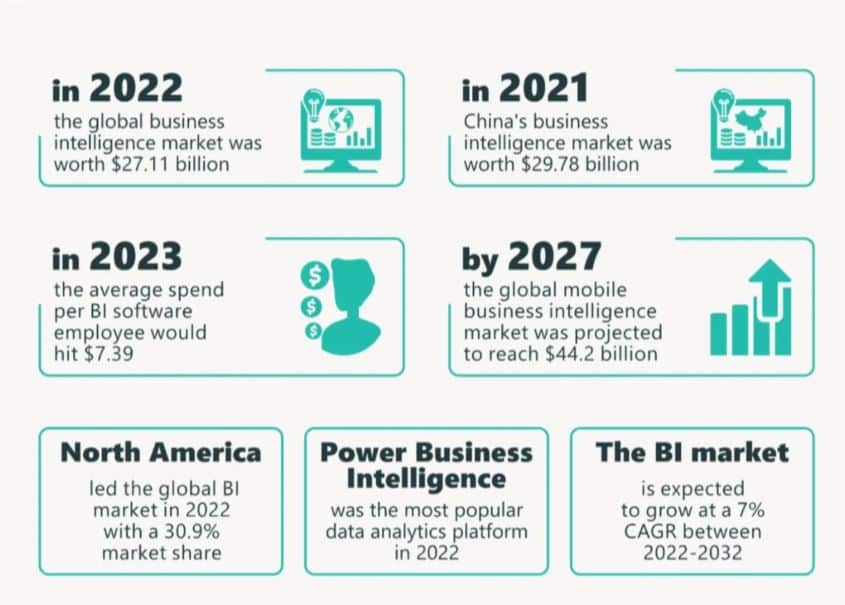
Here are some of the top Business Intelligence trends for 2026 that enterprises can practically use.
1. Augmented Analytics
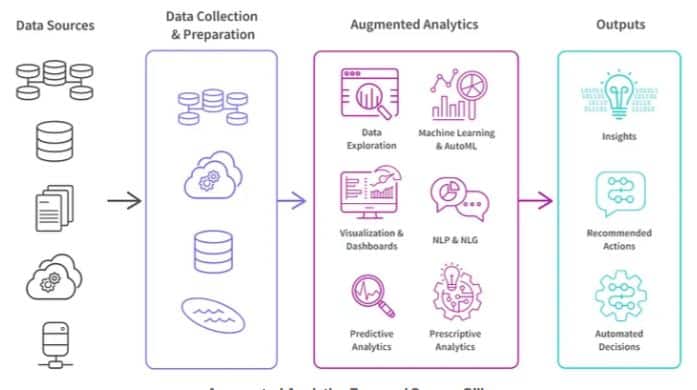
Some genuine time has passed since ‘AI in analytics’ was just a buzzword. In 2026, the term will bedelivering, and mid-sized organisations are going to get the most value. Augmented analytics feels like having a data scientist working around the clock with your team. It can detect anomalies, spot patterns, and areas of opportunity that would typically take days for manual discovery.
2. Evolution of Self-Service BI
“In the coming year, self-service analytics will evolve beyond just self-service for analysts. There will be self-service information for the masses delivered not through tools but through purpose-built interfaces and apps. Just as the ATM in banking evolved from a cash-dispensing machine to a full transaction and account management terminal, so too will self-service mature and spread to the masses.” -Dr. Rado Kotorov, Chief Innovation Officer at Information Builders
3. More Advanced, Customizable Visualizations
“There will be an emphasis on tools that will create more powerful graphics and, in particular, more advanced cloud authoring capabilities. While this will satisfy the data engineers, the industry will continue to struggle with user-friendly tools for the occasional consumer. Business analytics in the SMB space will slowly begin to move away from the traditional compliance reporting involving rows and columns to visualization snippets in the form of dashboards for browser-based applications, and simple graphical elements on mobile devices and tablets.” -Chuck Vigeant, M.Ed, President at Clearify
4. Natural Language Query (NLQ) and Conversational BI
As business intelligence becomes more democratized, Natural Language Query (NLQ) is gaining strong momentum. NLQ has revolutionized data interaction, eliminating the need for users to master complex query languages or navigate confusing interfaces to extract key insights. This shift empowers non-technical teams to access and analyze data conversationally, driving faster and broader decision-making.
5. Data Democratisation
Data literacy is becoming crucial for business users. It’s because BI’s true promise lies in accessible insights for decision-makers, and democratisation can only work when everyone trusts the numbers in front of them.
Data products embed this trust directly into the BI fabric with in-built quality scores, lineage, and governance policies, where each product is expressive of reliability. Because data has also been standardised and vetted, the democratisation becomes durable over time as well.
6. Self-Service Analytics at Scale
Another BI trend making all the right noises is self-service analytics.
What is self-service analytics?
It is a type of BI where end users are enabled to perform data analysis and then generate reports without the assistance of data science or IT teams. These tools offer intuitive interfaces and interactive dashboards, so that even non-technical users can perform complex data queries, create customised reports, and generate insights.
7. Data Governance and Trust in BI
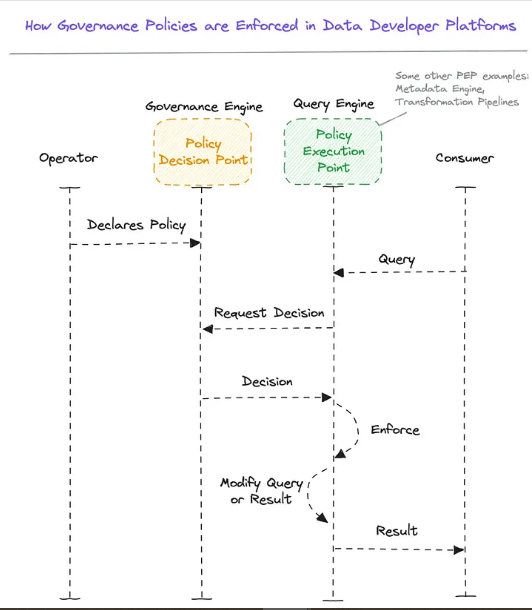
Data governance is another crucial BI trend, helping organisations address their structures, policies, and procedures not just to ensure the quality and quantity of data, but also to ensure compliance.
The core concept of ethical data governance is respecting individual rights and privacy in all data-related activities. At the same time, it also includes implementing practices that offer informed consent, strict access controls, and data anonymisation, among others.
8. A Screen In the Hand Is Worth Two On the Desk
“BI and visualization solutions that don’t support users moving from device to device, often and at speed, will not deliver the kinds of experience people want, including governed data discovery. Governed data enables users to ask ‘why?’ frequently throughout the discovery process, rather than questioning whether the data is correct when the report is submitted. Since everyone is using the same information, more efficient, accurate and timely decisions will be made.” -James Richardson, Business Analytic Strategist at Qlik.
9. The Rise Of API Deployment
In 2025, companies move towards an even broader use of [software-as-a-service] SaaS apps to complement or replace enterprise applications and, as mobile apps continue to multiply, the need for APIs and cloud connectivity will grow, with an increased emphasis on better developer tools and productivity.” -Mark Palmer, SVP of Event Processing and Integration at TIBCO Software Inc.
10. Data Is the New Water
“Data is everywhere and essential for businesses to live, grow, and thrive. In 2025, we will see the onset of ‘wars’ over access and usage rights over data, and monopolistic behavior from several companies seeking to restrict the ability of consumers and businesses to manage its free flow.” -Paul Weiskopf, Senior Vice President of Corporate Development at Domo
11. Cloud-Based BI Solutions
The future of business intelligence is undeniably cloud-native. Enterprises are rapidly adopting cloud-based BI tools that deliver flexible, scalable access to data, compute resources, and analytics in real time. These platforms let businesses dynamically adjust processing power and storage to match demand while enabling real-time monitoring of market shifts and customer behavior for sharper decision-making. However, juggling multiple cloud solutions can introduce integration challenges and complexity
12. AI in BI
One of the most important Business Intelligence trends for 2026 is the deep integration of AI capabilities into BI tools. AI’s ability to generate insights, automate analysis, and predict outcomes is transforming how organizations interact with and extract value from data.
By reducing manual effort, AI accelerates the entire BI lifecycle and can handle complex, large-scale datasets far beyond human capacity. However, there’s an important caveat.
AI is only as effective as the data it’s trained on. When models rely on inconsistent, ungoverned, or siloed data, the resulting insights can be biased or misleading. This is where data products become critical. Well-defined, governed data products act as guardrails for AI in BI, ensuring accuracy, trust, and real business value.
13. IoT and Real-Time Data Science
“The Internet of Things [IoT] will create new opportunities for data visualization and real-time analysis. BI tools capable of delivering on data from connected devices will thrive, and advanced analytics will not just be for data scientists anymore. With [the R statistical programming language] and predictive capabilities becoming pervasive through data analysis and visualizations, the realm of machine learning will become accessible to a broader group of regular people.” –James Phillips, Corporate Vice President of Microsoft’s Business Applications, Platform, and Intelligence (BAPI)
14. Affordable BI For SMBs
“Big Data analytics will play a pivotal role in the way various departments in a business, particularly sales and marketing, function. We can already see companies investing in this area. With monthly, user-based BI pricing getting as low as $10, more SMBs will start using sophisticated BI tools instead of just relying on spreadsheets.” -Raju Vegesna, Chief Evangelist at Zoho
15. Mobile Analytics Stands On Its Own
“Mobile analytics has grown up and moved out. It’s no longer just an interface to legacy BI products. In 2026, products with a fluid, mobile-first experience began to emerge. Working with data out in the world is going from being a chore to becoming a dynamic part of the analytics process.”
16. Analytics on Hadoop
Largest sets of data can be analyzed using SQL-based technology. Hadoop’s cheap storage and infinite scalability while analytics remained in the realm of SQL-based systems. In 2026, the face of analytics will change as companies can finally have it all and leverage Hadoop’s unparalleled power to run analytics directly in cluster thanks to the speed and flexibility of new SQL query engines like Spark and Presto.
17. Tech Giants Escalate the BI War
2025 saw Amazon’s QuickSight and IBM’s Watson Analytics Service enter the BI market, along with major enhancements from Microsoft to its Power BI suite. Oracle and SAP have been in the market for years, and will look to hit back against the newer players with significant investments in revamping their BI offerings. 2026 should also bring a major update from Google for its BigQuery BI platform, and who knows, maybe Apple will even enter the fray.
❓ FAQs: Business Intelligence Trends for 2026
1. What are the key Business Intelligence trends for 2026?
Major BI trends for 2026 include AI-driven analytics, data products and data mesh adoption, augmented analytics, real-time and predictive BI, and stronger data governance and privacy controls.
2. How is AI transforming Business Intelligence in 2026?
AI is enabling automated insights, natural language querying, predictive analytics, and faster decision-making, reducing manual analysis and making BI tools more accessible to non-technical users.
3. Why are data products important for BI in 2026?
Data products ensure data quality, consistency, and governance, acting as reliable inputs for AI-powered BI systems and preventing biased or inaccurate insights.
4. What role does real-time analytics play in modern BI?
Real-time analytics allows organizations to monitor operations, detect issues instantly, and make timely decisions, which is increasingly critical for competitive advantage in 2026.
5. How can organizations prepare for Business Intelligence trends in 2026?
Organizations should invest in AI-ready BI platforms, establish strong data governance, adopt data product thinking, upskill teams, and align BI initiatives with business objectives.
Related Posts

What Is Enterprise Mobility Management and Why It Matters
March 25, 2026The workplace has changed dramatically. Employees now expect to work from anywhere, ...

7 Best Knowledge Management Systems for Enterprise Organizations
March 14, 2026Enterprise organizations generate enormous amounts of information every day. Product documentation, internal ...

5 Best Bitnami Images Alternatives for 2026
March 10, 2026Container images have become a foundational element of modern software delivery. In ...

From Data to Decision-Making – How AI is Transforming Safety Programs
March 6, 2026The approach to industrial risk management is experiencing a fundamental shift. Organizations ...

Top 5 Virtual Hands-on Labs Solutions in 2026
March 6, 2026Virtual hands-on labs have become a critical component of how organizations train ...